Italian Surnames from the Nativity Scene, from the Three Kings to the Shepherds
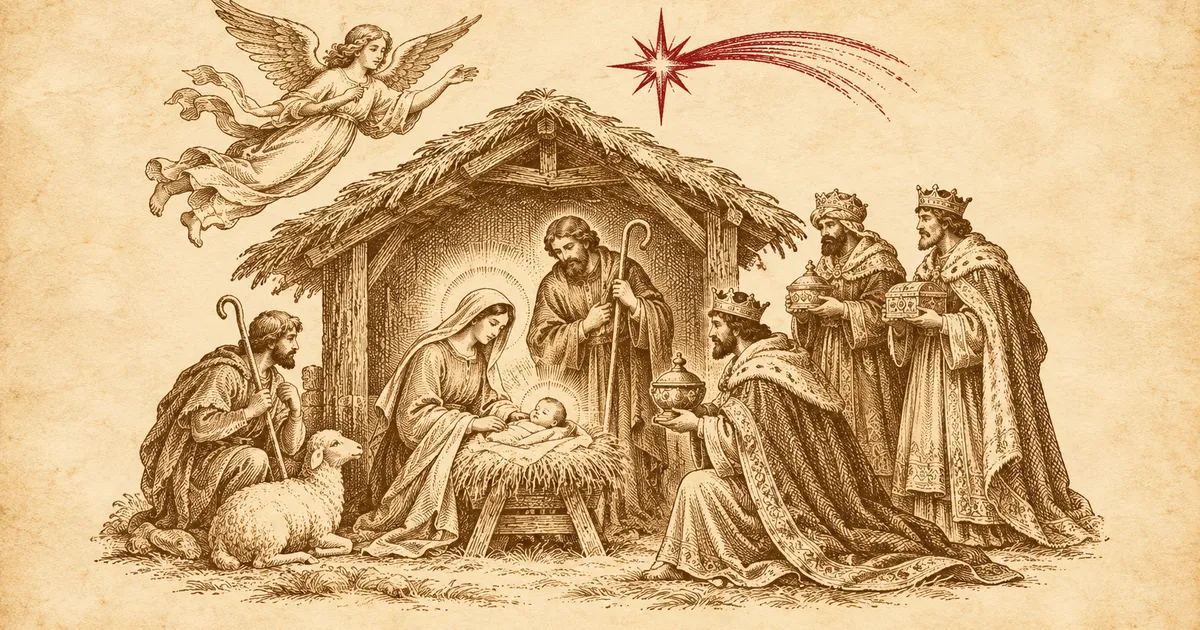
The Italian Nativity scene, the presepe, holds the Three Kings, Joseph, the angels, the shepherds and the star.
Many of those figures left a surname behind. The path is always the same. A name was given to a child out of devotion, and later it passed to his children as the family name.
Not all of these surnames come from the Nativity in the same way. Some were born from those figures, others only sound like them.
Where do the names of the Three Kings come from?
The Gospel of Matthew speaks of Magi who came from the East with gold, frankincense and myrrh. It doesn’t say how many there were, or what they were called. The number three, by tradition, comes from the three gifts.
The names arrived later. In Italian they are Gaspare, Melchiorre and Baldassarre: Caspar, Melchior and Balthazar in English. In Ravenna, in the basilica of Sant’Apollinare Nuovo, a mosaic still shows the three Magi with their names above them.
When a Gaspare became the head of a household, his children were “the ones of Gaspare.” That is how the surnames were born, like those from any other first name.
Which surnames come from Gaspare?
Gaspari is the best known. It comes from Gaspare, a name with an eastern root that scholars still debate. About 9,800 people carry it in Italy, mostly in the Veneto region, followed by Lombardy and Emilia-Romagna.
The same name produced other surnames, from the Veneto to Trentino. In Trentino the name was Gasperi, and the preposition fused with it: Degasperi means “those of Gaspare.” Alcide De Gasperi, born in Pieve Tesino in 1881, wrote it as two words.
What about Melchior and Balthazar?
Melchior is harder to spot, because in the Veneto it was pronounced Marchioro. That gave the surnames Marchioro and Marchiori, both typical of the region. Marchiori is the top surname in Mira, on the Brenta Riviera near Venice.
Balthazar comes from much farther away. It goes back to the Assyrian-Babylonian Bel-shar-uzur, “may Bel protect the king.” Bel was the supreme god of Babylon. The surname Baldassarri is spread across Romagna, Tuscany, the Marche, Umbria and Lazio. Today it is the top surname of Collazzone, a hill town in Umbria above the Tiber.
Why are there so many D’Angelos?
In Luke’s Gospel an angel brings the news of the birth to the shepherds. The name Angelo comes from the Greek ánghelos, which simply meant “messenger.” In the Middle Ages it was a name of good omen, given to place a child under heaven’s protection.
D’Angelo means “son of Angelo.” About 14,100 families carry it in Italy, mostly in Campania and Sicily. In Abruzzo it is the most common surname of the whole region. The same name gave De Angelis, the Latin form used by notaries, and Angelini and Angeli, more common in central and northern Italy.
If you are searching American records, watch the apostrophe. Abroad it was often dropped, and the same family can appear as Dangelo or DAngelo.
Where does Joseph fit in?
Joseph is the father of the Nativity, and a father in surnames too. Di Giuseppe means “son of Giuseppe,” Italian for Joseph. About 8,100 people carry it in Italy, with its heart in Abruzzo. In Civitella del Tronto, in the province of Teramo, it is among the three most common surnames.
Do Pastore and Stella come from the Nativity?
These two surnames call the Nativity to mind, but they usually don’t come from it.
Pastore, “shepherd,” almost always comes from the trade. It named the man who took the flocks to pasture. Only in some cases does it point to the “Good Shepherd,” meaning Christ, or to a priest, a shepherd of souls.
Stella, “star,” has a debated origin. It may come from the personal name Stella, from a nickname or from a place, such as Stella in Liguria or Stella Cilento. The name also spread thanks to a title of the Virgin Mary, Stella maris, “star of the sea.” The usual explanations of the surname don’t involve the star of the Magi.
And the surname Natale?
Natale is the Italian word for Christmas. As a first name it comes from the Latin natalis, “relating to birth.” With Christianity it became tied to the feast, and it was a name of good omen, perhaps for children born in those days.
Di Natale means “son of Natale,” and about half of those who carry it in Italy live in Sicily. Natale, without the “Di,” is the top surname of Nusco, in the province of Avellino.
Does a Nativity surname tell you who your ancestors were?
No. Gaspare, Angelo, Giuseppe and Natale were common names all over Italy. Each surname was born many times, in towns far apart, from different men.
The origin of a surname tells you which name your family comes from. To find out who that first Gaspare or Angelo was, you need records. If your family emigrated, start where they arrived: passenger lists, naturalization papers and draft cards can give the Italian hometown. From there, Italian civil and parish registers take you further back.
Want to know where all your family’s surnames come from? The three volumes collect hundreds of them, divided by area of Italy. Each surname has its own entry: origin, meaning, where it lives today and a fun fact.
 Surnames of Northern Italy
 Surnames of Central Italy
 Surnames of the South and the Islands