
Tuscany’s surnames, people by people
Before the Romans, Tuscany was the land of the Etruscans, and even its name comes from them: the Romans called them Tusci and their land Tuscia. Their language died out almost two thousand years ago, but it lives on in place names, and places sometimes gave rise to surnames: Volterrani comes from Volterra, one of the great Etruscan cities. Then the Romans founded Lucca, Pisa and Florence, and their Latin became Tuscan, the basis of Italian.
In 568 the Lombards arrived, and in Tuscany their main center was Lucca. Names that later became surnames already appear in the Lucca charters: a deed from 720 names a cleric Geminiano, one from 760 a priest Frosino. In the Middle Ages Pisa’s ships sailed as far as Constantinople, and newcomers from far away often got a nickname saying where they came from. In Florence everything revolved around the Arti, the trade guilds, and a trade could become a surname: Mugnai is the miller, Ciabatti the cobbler.
In 1445 the Spedale degli Innocenti opened in Florence, where children whose families could not raise them were left: Innocenti, Degl’Innocenti and Nocentini come from there. In the late 1500s the Medici opened Livorno to merchants of every nation and faith. And from the mountains, from the Garfagnana to Amiata, many people left in the 19th and 20th centuries, for the Americas, France and Scotland.
The volume gives a chapter to each of these nine peoples and stories. For nearly all of them it lists the surnames in the book that carry their mark.
How to recognize a Tuscan surname
Some signs are easy to spot. In the workshops and streets nobody went by their full name: Francesco was Cecco, Giovanni was Vanni, Bartolomeo was Meo, Gregorio was Goro. From them come Cecchi, Vanni, Meoni and Gori, and more than half the surnames in this book come from a personal name. Then come the pet endings, one on top of another: -ini, -ucci, -etti, -ozzi. So a single Iacopo gives Puccini, Puccioni and Puccinelli.
The final -i marks the family: the Puccini are “Puccino’s people,” his children and grandchildren. In the notaries’ Latin records they wrote filius Puccini, “son of Puccino,” and that form stuck. Tuscany was one of the first parts of Italy to use surnames: in the 13th- and 14th-century records of Florence, Pisa, Siena and Lucca, many family names are already the ones we know today.
Province by province
At the back of the volume an index gathers the surnames most common in each province. There are 280 surnames from the book, spread across the ten provinces from Arezzo to Siena. Then comes the list of the 59 Tuscan towns where a surname from the book is the most common. In Florence, No. 1 is Innocenti, the foundlings’ surname.
Is your surname in the volume?
Type it below: we'll tell you right away if it's there, and in which volume.
- Angeli
- Bacci
- Baglioni
- Bagnoli
- Baldi
- Baldini
- Ballerini
- Bandinelli
- Barni
- Baroncelli
- Baronti
- Barsotti
- Bartalucci
- Bartoli
- Bartolini
- Bartolozzi
- Bellandi
- Bellucci
- Bencini
- Benedetti
- Benelli
- Benvenuti
- Bernardini
- Berni
- Bertelli
- Berti
- Bertini
- Betti
- Biagi
- Biagini
- Biagioni
- Biagiotti
- Biancalani
- Bianchini
- Bigazzi
- Bindi
- Bini
- Biondi
- Boldrini
- Bonacchi
- Brizzi
- Brogi
- Bruni
- Buti
- Calamai
- Cambi
- Cantini
- Capecchi
- Cappelli
- Cappellini
- Carli
- Carmignani
- Casalini
- Casini
- Castellani
- Ceccherini
- Cecchi
- Cecchini
- Cecconi
- Cheli
- Chiti
- Ciampi
- Cini
- Cioni
- Cipriani
- Coli
- Coppini
- Corsi
- Degl’Innocenti
- Dei
- Dini
- Donati
- Donnini
- Ermini
- Favilli
- Fedi
- Ferrini
- Fiaschi
- Fontanelli
- Fontani
- Franceschi
- Francesconi
- Franci
- Francini
- Frediani
- Frosini
- Galeotti
- Galletti
- Gasperini
- Gelli
- Gemignani
- Giacomelli
- Giannelli
- Giannetti
- Giannini
- Giannoni
- Giannotti
- Giorgetti
- Giorgi
- Giovannelli
- Giovannetti
- Giuntini
- Giuntoli
- Giusti
- Gori
- Grazzini
- Guerrieri
- Guerrini
- Guidotti
- Innocenti
- Landi
- Landini
- Lari
- Lazzeri
- Lazzerini
- Lenzi
- Lippi
- Lorenzini
- Lotti
- Lucchesi
- Maffei
- Magrini
- Manetti
- Mannucci
- Marchi
- Marcucci
- Mariotti
- Martini
- Masi
- Masini
- Massai
- Matteucci
- Mazzanti
- Mazzei
- Meini
- Melani
- Menichetti
- Meoni
- Meucci
- Michelotti
- Migliorini
- Montagnani
- Morelli
- Morganti
- Mori
- Mugnai
- Mugnaini
- Nannini
- Nardi
- Nardini
- Natali
- Nesi
- Nesti
- Nocentini
- Pacini
- Pagliai
- Pagni
- Panichi
- Paoletti
- Paoli
- Paolini
- Papi
- Papini
- Pardini
- Parigi
- Parri
- Parrini
- Pasquini
- Pellegrini
- Peruzzi
- Petri
- Picchi
- Piccini
- Pieri
- Pierini
- Pieroni
- Pistolesi
- Pratesi
- Pucci
- Puccini
- Raffaelli
- Ristori
- Romoli
- Rosi
- Salvadori
- Salvini
- Santini
- Senesi
- Signorini
- Simoncini
- Stefanini
- Tani
- Tesi
- Turchi
- Vanni
- Vannini
- Vannucchi
- Vannucci
- Vettori
- Viti
- Acciai
- Aiazzi
- Ammannati
- Badii
- Baglini
- Baldanzi
- Banti
- Barbagli
- Bardazzi
- Barsacchi
- Bartalesi
- Bartali
- Bartalini
- Becagli
- Becattini
- Bechelli
- Bechini
- Becucci
- Belluomini
- Bertelloni
- Bertocchini
- Bettarini
- Bigiarini
- Bimbi
- Bonciani
- Bonuccelli
- Borgioli
- Bracaloni
- Bracciali
- Calonaci
- Campigli
- Casarosa
- Ceccanti
- Ceccatelli
- Cellai
- Cencini
- Cherici
- Chiarugi
- Ciabatti
- Ciappi
- Citi
- Ciurli
- Cresti
- Demi
- Doveri
- Failli
- Falorni
- Fantacci
- Fantechi
- Federighi
- Focardi
- Fornai
- Francalanci
- Fruzzetti
- Fulceri
- Gabbrielli
- Gennai
- Giannecchini
- Gorelli
- Gronchi
- Guarducci
- Guazzini
- Lapini
- Lascialfari
- Lastrucci
- Lencioni
- Leporatti
- Macelloni
- Magnolfi
- Mannari
- Marinai
- Marradi
- Matteoli
- Mazzuoli
- Meacci
- Menci
- Messeri
- Moncini
- Mosti
- Nistri
- Palagi
- Pianigiani
- Pinzauti
- Profeti
- Puccinelli
- Puccioni
- Ramacciotti
- Rigacci
- Risaliti
- Sampieri
- Sbrana
- Sestini
- Simi
- Tarchi
- Tavanti
- Tuci
- Ulivieri
- Verdiani
- Vignozzi
- Volterrani
Surnames in red also have their own booklet.
FAQ
Is my surname in the volume?
The full list of the 300 surnames is on this page. If yours isn’t there, request it through our contact page: new booklets come from the most requested surnames.
How is it different from the volume on Central Italy?
The Central Italy volume picks 300 surnames from four regions. This one is devoted to Tuscany alone: nine chapters on the region’s peoples and stories and, when there is one, the place in Tuscany where each surname ranks highest. 121 surnames are in both: the other 179 you’ll find only here.
Will I find the surnames of my province?
At the back of the volume an index gathers the surnames most common in each province. There are 280 surnames from the book, spread across the ten provinces, not just Florence. There’s also the list of the 59 Tuscan towns where a surname from the book is the most common.
What’s the difference between the volume and a surname booklet?
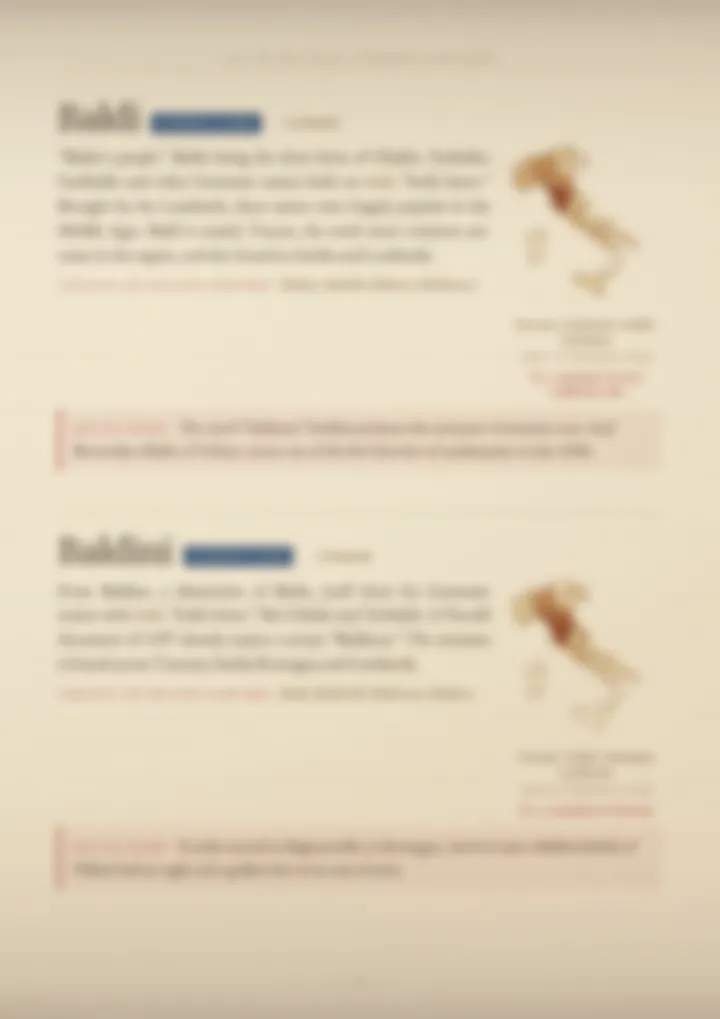
In the volume each surname has a half-page entry: origin, map, variants and a fun fact. The booklet is devoted to a single surname and tells its story, its towns and its distribution in 12-19 pages. It also has a family tree and a surname scroll personalized with that surname.
Does the volume tell me who my ancestors were?
No. A surname tells you where a word comes from, and two families with the same surname can have completely different stories. At the back of the volume there’s a guide to searching for your ancestors in the archives, free and from home. It includes tips for Tuscany, where civil registration predates Unification: it arrived with Napoleon in 1808 and went on in the Grand Duchy’s registers until 1865.
Does the volume include my surname’s coat of arms?
No, because a surname has no coat of arms. A coat of arms belonged to one specific branch of a family, not to everyone who carries the surname. When a fun fact mentions one, the entry says which family it belonged to.
What if scholars disagree about the origin?
We tell you. When an origin is certain, it’s written as certain. When it isn’t, the entry carries the gray “disputed origin” badge and gives you the theories.
Can I print it?
Yes, for personal and family use: you can print it for yourself and your relatives.
