
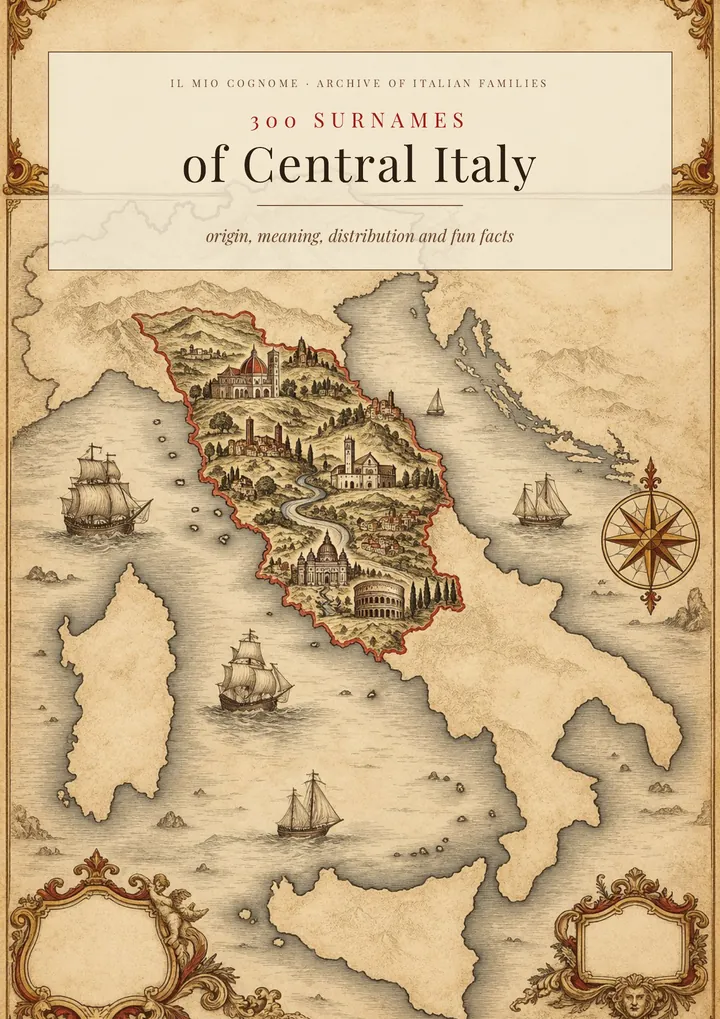

Central Italy’s surnames, story by story
The very idea of a family name was born here. The Etruscans, between the Arno and the Tiber, already had a personal name and a family name passed from father to son, and the Romans used the same system. With the fall of the Empire people went back to having a single name, but many Roman names survived thanks to the saints and, after the year 1000, became surnames again: Valeri, Fabrizi, Massimi.
Then came the Lombards, with the Duchy of Spoleto and Lucca as the capital of their Tuscia: from them come Guidi, Landi, Baldini. For more than a thousand years Lazio, Umbria and the Marche were ruled by the Popes, and the world of saints, pilgrims and confraternities lives on in Santi, Benedetti, Pellegrini. In the Tuscan cities of merchants and bankers, surnames grew out of fathers’ pet names: Cecco, Vanni, Nardo and Bindo became Cecchi, Vanni, Nardi and Bindi. Then there are the foundlings of Florence’s Spedale degli Innocenti, the Jews of Rome with the names of Lazio towns, and the newcomers who brought the name of their city with them: Lucchesi, Pratesi, Romagnoli.
The volume gives a chapter to each of these eight stories, with the surnames in the book that carry its mark.
How to recognize a surname from Central Italy
The final -i is the family plural: the Mancini, the Santi. Diminutives in -ini, -elli, -etti and -ucci are everywhere: Bartolini, Marinelli, Moretti, Paolucci. In Lazio there’s De with the notaries’ Latin -is: De Angelis, De Santis, De Carolis, meaning “of the family of the Angeli, the Santi, the Caroli.” And in Rome many foundlings became Proietti, from the Latin proiectus, “exposed.”
Is your surname in the volume?
Type it below: we'll tell you right away if it's there, and in which volume.
- Agostinelli
- Agostini
- Alessandrini
- Alunni
- Angeli
- Angelini
- Angelucci
- Antonelli
- Antonini
- Bacci
- Baldelli
- Baldi
- Baldini
- Baldoni
- Balducci
- Barsotti
- Bartoli
- Bartolini
- Bartolucci
- Battisti
- Belli
- Bellucci
- Benedetti
- Benvenuti
- Bernardini
- Berti
- Bertini
- Betti
- Biagi
- Biagini
- Biagioni
- Bianchini
- Bianconi
- Bindi
- Bini
- Biondi
- Bizzarri
- Bonanni
- Brogi
- Brunetti
- Bruni
- Bucci
- Campoli
- Cantini
- Cappelli
- Capriotti
- Cardinali
- Carletti
- Carloni
- Casini
- Castellani
- Ceccarelli
- Cecchetti
- Cecchi
- Cecchini
- Cecconi
- Ceci
- Cesarini
- Ciarrocchi
- Cingolani
- Cioni
- Cipriani
- Corsi
- Costantini
- Cruciani
- De Angelis
- De Carolis
- De Paolis
- De Santis
- Dini
- Dominici
- Donati
- Fabrizi
- Falcinelli
- Federici
- Felici
- Ferranti
- Ferretti
- Fioravanti
- Fiorini
- Fiorucci
- Fratini
- Gabrielli
- Gentili
- Giannini
- Giorgi
- Giovannini
- Giuliani
- Giusti
- Gori
- Graziani
- Grilli
- Guerrini
- Guidi
- Innocenti
- Landi
- Latini
- Lattanzi
- Lenzi
- Liberati
- Lisi
- Lotti
- Lucchesi
- Lucci
- Luciani
- Lupi
- Luzi
- Mancinelli
- Mancini
- Manetti
- Mannucci
- Marcelli
- Marchetti
- Marchionni
- Marconi
- Mariani
- Marinelli
- Marini
- Mariotti
- Marrocco
- Masi
- Masini
- Massimi
- Mattei
- Mattioli
- Mazzoni
- Melani
- Mencarelli
- Mercuri
- Meucci
- Montesi
- Morelli
- Moretti
- Morganti
- Mori
- Moriconi
- Nannini
- Nardi
- Nesi
- Nocentini
- Ottaviani
- Pacini
- Pagni
- Palombi
- Palombo
- Paoletti
- Paoli
- Paolini
- Paolucci
- Papini
- Pardini
- Paris
- Pascucci
- Pasquini
- Pellegrini
- Peruzzi
- Petrini
- Petrucci
- Pettinari
- Pieri
- Pierini
- Pieroni
- Pompili
- Pratesi
- Principi
- Proietti
- Pucci
- Ragni
- Raponi
- Renzi
- Ricci
- Rocchi
- Romagnoli
- Romani
- Rosati
- Roscini
- Rosi
- Sabatini
- Sabbatini
- Salvadori
- Salvati
- Santarelli
- Santi
- Santini
- Santoni
- Serafini
- Severini
- Signorini
- Simonetti
- Tomei
- Tosti
- Traini
- Urbani
- Valentini
- Valeri
- Vanni
- Vannini
- Vannucci
- Venditti
- Volpi
- Acciarri
- Alonzi
- Amabili
- Ammannati
- Barbagli
- Bardazzi
- Baronti
- Barsacchi
- Bartalesi
- Bartali
- Belluomini
- Bertocchini
- Biancalani
- Bigazzi
- Bonacchi
- Bonuccelli
- Bracaloni
- Bracciali
- Brufani
- Calamai
- Caponera
- Capparella
- Carassai
- Casarosa
- Catenacci
- Cedrone
- Cervoni
- Chiti
- Ciappi
- Colasanti
- Coppari
- Cresti
- Degl’Innocenti
- Fagiolo
- Faiola
- Falorni
- Fantechi
- Favaroni
- Ferracuti
- Fornai
- Fraioli
- Fulceri
- Gasbarra
- Gattari
- Gennai
- Gronchi
- Guazzini
- Guzzini
- Iacovacci
- Lapini
- Lascialfari
- Lauretti
- Longetti
- Ludovisi
- Lupino
- Magnolfi
- Mammucari
- Marcoionni
- Marinai
- Massai
- Mastrangeli
- Mastrantoni
- Meini
- Morgia
- Morresi
- Mugnaini
- Necci
- Nistri
- Offidani
- Pagliai
- Pannozzo
- Panzironi
- Perciballi
- Pietrobono
- Pigliapoco
- Pignattini
- Pinzauti
- Polenta
- Pomponi
- Profeti
- Quadrana
- Risaliti
- Sabellico
- Saccucci
- Sanchioni
- Sbardella
- Scacco
- Serfilippi
- Sestili
- Sorcinelli
- Sorge
- Sperduti
- Staffolani
- Stazi
- Tini
- Trabalza
- Ubertini
- Verdini
- Zallocco
- Zangrilli
Surnames in red also have their own booklet.
FAQ
Is my surname in the volume?
The full list of the 300 surnames is on this page. If yours isn’t there, request it through our contact page: new booklets come from the most requested surnames.
What’s the difference between the volume and a surname booklet?
In the volume each surname has a half-page entry: origin, map, variants and a fun fact. The booklet is devoted to a single surname and tells its story, its towns and its distribution in 12-19 pages, with a family tree and a scroll made out to that surname.
Does the volume tell me who my ancestors were?
No. A surname tells you where a word comes from, and two families with the same surname can have completely different stories. At the back of the volume there’s a guide to start searching for your ancestors in the archives, free and from home.
Can I print it?
Yes, for personal and family use: you can print it for yourself and your relatives.


