
Emilia-Romagna’s surnames, people by people
Before the Romans, the Po plain belonged to the Etruscans, who called Bologna Felsina, and then to the Celts: the Boii Gauls, who according to many scholars gave the city its Latin name, Bononia. From there come Bolognesi and Cevenini. In 187 BC the consul Marcus Aemilius Lepidus built a straight road from Rimini to Piacenza, the Via Emilia, which gave the region its name. Ravenna was the capital of the Western Empire and then, for almost two centuries, of the Byzantines: the Lombards called those lands Romania, “the land of the Romans,” and that’s how Romagna was born. With the Lombards and the Franks came warriors’ names like Gandolfo, Gherardo and Lamberto, the source of Gandolfi, Gherardi and Lambertini.
Under the porticoes of the cities, a trade became a nickname and the nickname a surname: Fabbri, Calzolari, Sarti, Muratori. With the Este in Ferrara, the Farnese in Parma and Piacenza and the pope in Bologna, anyone who moved to a new city was called by the name of the one they came from: Reggiani, Mantovani, Veronesi. Babies left at the hospitals were given surnames like Degli Esposti, “entrusted to everyone’s charity,” and Incerti, “father unknown.” And from the Apennines, where chestnut flour was the bread of the poor, many people left between the 1800s and 1900s for the Americas, France and Britain.
The volume gives a chapter to each of these eight peoples and stories, and for each one it lists the surnames in the book that carry its mark.
How to recognize a surname from Emilia or Romagna
In Bologna, the city of notaries, people had to be told apart in legal records early on: in 1257 the Commune freed the serfs of its territory and wrote down their names, one by one, in the Liber Paradisus. Some signs are easy to spot. Shortened names: Zanni from Giovanni, Righi from Arrigo or Federigo, Naldi from Rinaldo, Pirini from Piero. Then the pet endings, -ini, -ozzi, -uzzi, -otti: so one Domenico, Mingo, gave Mingozzi, Minguzzi and Menozzi. And the final -i marks the family: the Zannoni are “Zannone’s people,” because in the notaries’ Latin records people wrote filius Zannoni, “son of Zannone.”
Province by province
At the back of the volume an index gathers, province by province, the surnames most common there: 274 surnames from the book, spread across the nine provinces from Bologna to Rimini. Then comes the list of the 51 towns in Emilia-Romagna where a surname from the book is the most common: in Rimini, for example, No. 1 is Fabbri, the smith’s family.
Is your surname in the volume?
Type it below: we'll tell you right away if it's there, and in which volume.
- Amadori
- Ansaloni
- Ascari
- Balboni
- Bandini
- Baraldi
- Battistini
- Bellei
- Belletti
- Benassi
- Benini
- Bergamini
- Bersani
- Berselli
- Bertani
- Bertozzi
- Bigi
- Bocchi
- Bolognesi
- Bonacini
- Bonazzi
- Bondi
- Bonfiglioli
- Boni
- Bonini
- Bonora
- Borghi
- Borsari
- Bortolotti
- Boschi
- Bosi
- Bottazzi
- Botti
- Bulgarelli
- Calderoni
- Calzolari
- Campanini
- Canali
- Carini
- Caroli
- Casadei
- Casadio
- Casali
- Caselli
- Catellani
- Cattani
- Cavalieri
- Cavallari
- Cavallini
- Cavani
- Cavicchi
- Cavina
- Cesari
- Chiarini
- Cicognani
- Cocchi
- Collina
- Corradi
- Corradini
- Costi
- Cremonini
- Davoli
- Degli Esposti
- Dondi
- Fabbri
- Facchini
- Fantini
- Fantuzzi
- Fava
- Ferrarini
- Ferretti
- Fini
- Fogli
- Fontanesi
- Forni
- Foschi
- Franchini
- Galassi
- Gallerani
- Gamberini
- Gandolfi
- Gardini
- Garuti
- Gavioli
- Gennari
- Gentilini
- Gherardi
- Ghetti
- Giordani
- Giovanardi
- Giovannini
- Goldoni
- Golinelli
- Govoni
- Gozzi
- Grandi
- Grilli
- Gualandi
- Guerra
- Guerzoni
- Guidetti
- Guidi
- Incerti
- Iori
- Iotti
- Laghi
- Lambertini
- Lanzoni
- Lelli
- Liverani
- Lodi
- Lolli
- Losi
- Lucchi
- Lugli
- Luppi
- Maccaferri
- Maestri
- Magnani
- Maini
- Malagoli
- Malaguti
- Malavasi
- Manfredini
- Mantovani
- Manzini
- Marani
- Martelli
- Massari
- Mattioli
- Mazzini
- Mazzocchi
- Mazzoli
- Mazzoni
- Mazzotti
- Medici
- Melandri
- Melloni
- Menegatti
- Menozzi
- Merli
- Messori
- Monari
- Montanari
- Montorsi
- Morini
- Muratori
- Naldi
- Nanni
- Paganelli
- Pancaldi
- Piccinini
- Poggi
- Prati
- Ragazzini
- Ravaglia
- Ravaioli
- Rebecchi
- Reggiani
- Righi
- Romagnoli
- Saccani
- Sacchetti
- Sangiorgi
- Santi
- Sarti
- Sassi
- Savini
- Semprini
- Severi
- Simoni
- Spaggiari
- Stanzani
- Tagliaferri
- Tanzi
- Tassinari
- Tedeschi
- Tonelli
- Toni
- Torelli
- Turci
- Ugolini
- Vaccari
- Vandelli
- Vecchi
- Venturelli
- Venturi
- Veronesi
- Vezzani
- Vignali
- Vignoli
- Vincenzi
- Visani
- Zanasi
- Zanelli
- Zanni
- Zannoni
- Zerbini
- Zini
- Zucchini
- Adani
- Aimi
- Ancarani
- Baccolini
- Barbolini
- Bazzocchi
- Bedogni
- Beghelli
- Benfenati
- Bergonzini
- Bergonzoni
- Biavati
- Bigliardi
- Borgatti
- Bovina
- Brighi
- Brigliadori
- Cacciari
- Camellini
- Camporesi
- Candini
- Carretti
- Casolari
- Castagnetti
- Castaldini
- Cenacchi
- Cervellati
- Cevenini
- Cimatti
- Clo
- Cocconi
- Codeluppi
- Comastri
- Dallari
- Dalmonte
- Davolio
- Faedi
- Fiorellini
- Forghieri
- Frabetti
- Fregni
- Gaddoni
- Garavini
- Giacobazzi
- Giuffredi
- Giunchi
- Gnudi
- Guareschi
- Iemmi
- Lasagni
- Ligabue
- Lipparini
- Lusetti
- Lusuardi
- Manuzzi
- Marmiroli
- Maserati
- Mazzari
- Menta
- Meschiari
- Migani
- Mingozzi
- Minguzzi
- Missiroli
- Mongardi
- Montalti
- Morigi
- Morri
- Muccioli
- Musiani
- Pagliarani
- Pellacani
- Penazzi
- Pirazzini
- Pirini
- Poluzzi
- Prampolini
- Predieri
- Rabitti
- Rimondi
- Roli
- Roncarati
- Ruini
- Salmi
- Scardovi
- Servidei
- Sighinolfi
- Silingardi
- Solmi
- Suzzi
- Titi
- Tugnoli
- Ugolotti
- Valmori
- Vandi
- Venturoli
- Vezzali
- Zauli
- Zironi
- Zoboli
FAQ
Is my surname in the volume?
The full list of the 300 surnames is on this page. If yours isn’t there, request it through our contact page: new booklets come from the most requested surnames.
How is it different from the volume on Northern Italy?
The Northern Italy volume picks 300 surnames from eight regions. This one is devoted to Emilia-Romagna alone: eight chapters on the region’s peoples and stories and, when there is one, the place where each surname ranks highest in the region. 35 surnames are in both: the other 265 you’ll find only here.
Will I find the surnames of my province?
At the back of the volume an index gathers, province by province, the surnames most common there: 274 surnames from the book, spread across the nine provinces from Bologna to Rimini. There’s also the list of the 51 towns in Emilia-Romagna where a surname from the book is the most common.
What’s the difference between the volume and a surname booklet?
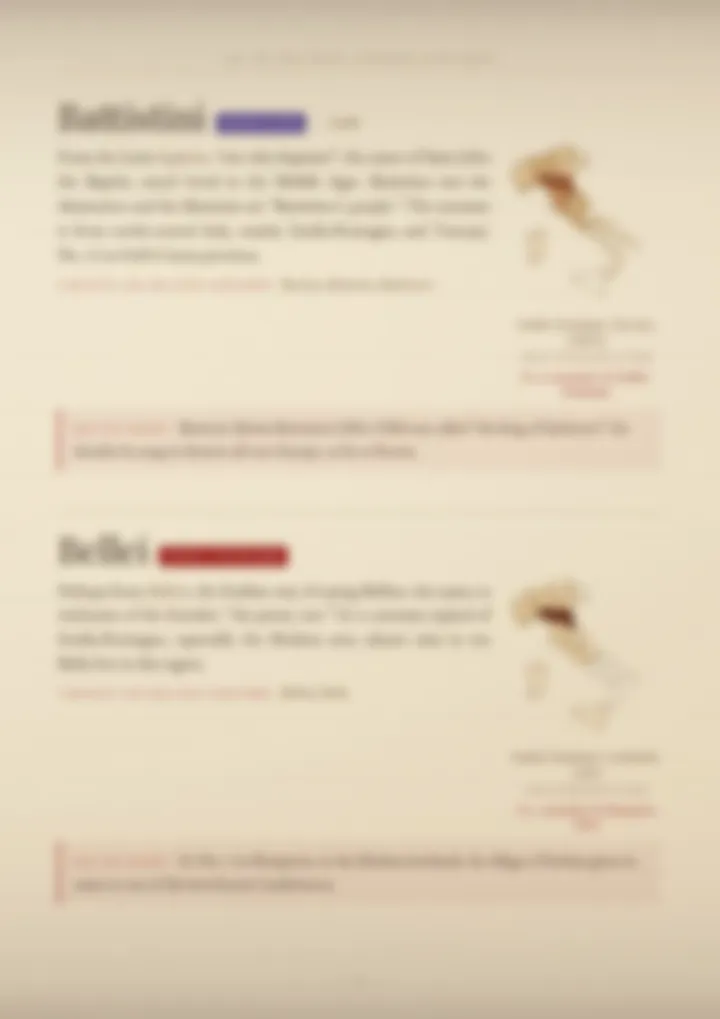
In the volume each surname has a half-page entry: origin, map, variants and a fun fact. The booklet is devoted to a single surname and tells its story, its towns and its distribution in 12-19 pages, with a family tree and a surname scroll personalized with that surname.
Does the volume tell me who my ancestors were?
No. A surname tells you where a word comes from, and two families with the same surname can have completely different stories. At the back of the volume there’s a guide to start searching for your ancestors in the archives, free and from home, with tips for Emilia-Romagna, where Italian civil registration begins in 1866, after the Napoleonic one, and in the Duchy of Parma and Piacenza civil registers went on even after the Restoration.
Does the volume include my surname’s coat of arms?
No, because a surname has no coat of arms: a coat of arms belonged to one specific branch of a family, not to everyone who carries the surname. When a fun fact mentions one, the entry says which family it belonged to.
What if scholars disagree about the origin?
We tell you. When an origin is certain, it’s written as certain; when it isn’t, the entry carries the gray “disputed origin” badge and gives you the theories.
Can I print it?
Yes, for personal and family use: you can print it for yourself and your relatives.