Was Your Family’s Name Changed at Ellis Island?
In The Godfather Part II, a nine-year-old boy from Sicily steps off the boat in New York. He doesn’t answer. Someone reads the tag on his coat, and the clerk writes down his village as his surname: Vito Andolini becomes Vito Corleone. It’s one of the most famous scenes in American cinema. The records say it didn’t happen that way at Ellis Island.
Many Italian American families tell a version of the same story. Great-grandpa arrived, an official misheard him, and the family has carried the wrong name ever since. Here’s what the records say, and why it matters if you want to find your family in Italy.
Did officials at Ellis Island change immigrants’ names?
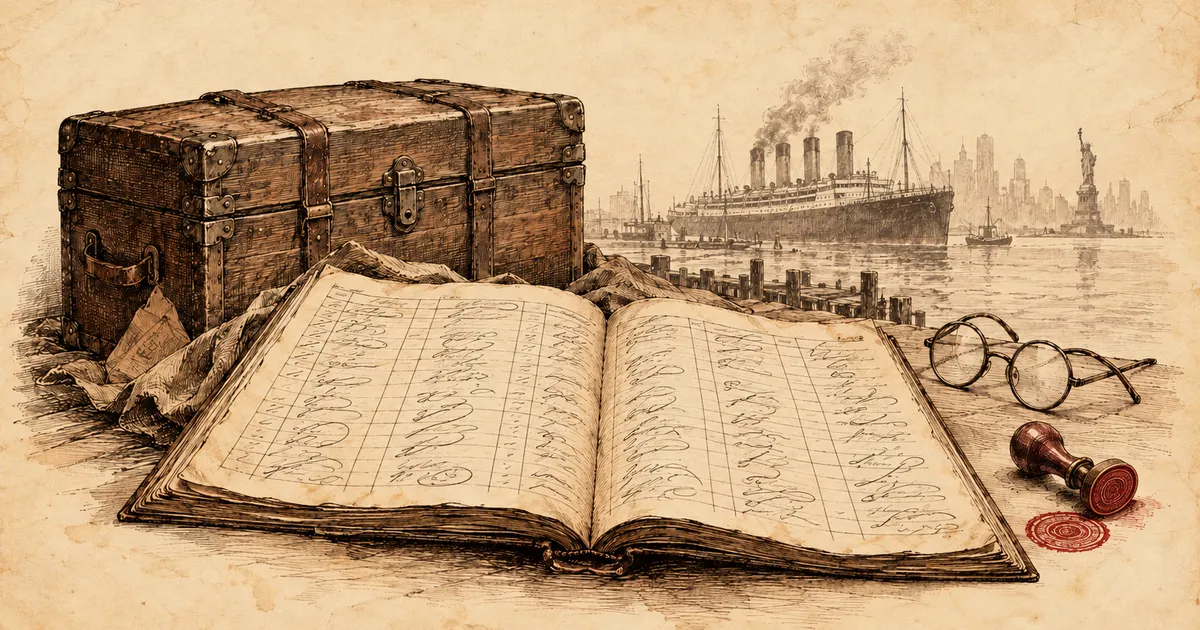
No. According to the historians of the U.S. Citizenship and Immigration Services, passenger lists were not written at Ellis Island. They were filled in abroad, starting when the emigrant bought his ticket, often in an office not far from home. For Italians, the shipping line completed the list before the ship left Naples, Palermo or Genoa.
When the ship docked, inspectors worked from that list. They asked the same questions again to confirm who each person was. Their rules told them not to change a name unless the immigrant asked or the original was proven wrong. The National Archives puts it plainly: federal immigration agents were never authorized to change anyone’s name.
Language wasn’t the obstacle the movie suggests. Between 1892 and 1924, about a third of the inspectors were foreign-born themselves. Inspectors spoke an average of three languages and were assigned to passengers by language, with interpreters on hand for the rest.
So where did the spelling change?
In two places, mostly. The first is paper. A name copied from a ticket to a manifest, then to a connecting ship, could pick up a mistake at every step. The more connections on the journey, the more copies, and the more chances to get a letter wrong. A wrong letter written in Naples traveled to New York with the passenger. Accents also tended to disappear along the way.
The second, and the more common, is the family itself. Many immigrants changed their names on their own, usually within their first five years in the country. A shorter name helped at a job interview and spared the children jokes at school. Sometimes it was just a matter of spelling the name the way Americans pronounced it. When families later said the name “changed at Ellis Island,” they often meant something larger: everything that changed in those first years.
That’s also why a surname can look different from one document to the next. The census taker wrote what he heard, the school wrote what the teacher understood, and the family settled on one version only later.
Many variants, one family
Some differences are older than the journey. Italian surnames already had several spellings at home. Russo is also Lorusso and Lo Russo in Apulia, Russotto and Russello in Sicily. Esposito, the surname given to abandoned children in Naples, is also Sposito in Campania and Sicily, and Esposti in Emilia-Romagna.
So two branches of a family can arrive in America with two spellings and still share the same village and the same great-grandparents. Before deciding a record isn’t yours, look for the variants.
First names moved too, and they often moved further than surnames. Giuseppe became Joseph, Giovanni became John, Vincenzo became Vincent. A great-grandfather known in the family as Joe may appear on the passenger list, and in the Italian birth register, as Giuseppe. When a search finds nothing, try the Italian first name before giving up on the surname.
How to find your family’s original surname
Start from the documents made in America, not from the family story. Since 1906, naturalization records have had to note any change of name. So a declaration of intention or a petition for naturalization often shows the name the immigrant was born with. Draft cards and census records add more spellings to try.
Then go back to the passenger list. Search for the Italian spelling, and for the variants. The manifest usually gives the age, the last place of residence and sometimes the town of birth. That town is the key to everything that follows.
Then cross the ocean. With the town in hand, the Italian civil registers of births, marriages and deaths are often online for free. Our guide to the Portale Antenati explains how to find a birth record and climb back one generation at a time.
Two warnings. Don’t expect one perfect document: names drift, and the truth usually comes from putting three or four records side by side. And keep the family story, even if the clerk part is wrong. It often hides a real clue, like the name of the village or the year the first relative left.
 Surnames of Northern Italy
 Surnames of Central Italy
 Surnames of the South and the Islands
And your surname, where does it come from? Its story, written for you: origin, records, towns and a map of the families in a booklet of its own. Or browse the surnames of cities and regions.