October 2, 2026 · 6 min read
How to Find Your Italian Ancestors on the Portale Antenati

A great-grandfather born in a town nobody remembers anymore, a grandmother known only by her first name. Finding them used to mean going to the archives in person. Today many of those registers can be browsed from home, for free, on the Portale Antenati of Italy’s Ministry of Culture. The site is also available in English.
The portal doesn’t work like a search engine, though. Here’s what it really holds and how to use it.
What’s on the Portale Antenati?
Photos of the civil registration records (stato civile) kept in the Italian State Archives: births, marriages, deaths. Some archives also have draft lists and military service records. Most of the photos were taken by FamilySearch, under an agreement with the Ministry signed in 2011.
The registers fall into three periods: the Napoleonic civil registration (1806-1815), the Restoration (1815-1865), and the Italian one, from 1865 onward.
There’s a privacy limit. You can only see births from at least 100 years ago, and marriages and deaths from at least 70.
When do the records start?
It depends on where your ancestors lived. In mainland southern Italy, civil registration runs without a break from 1809. In Sicily it starts in 1820. Only from 1866 does it cover every region, with a few exceptions: Lazio starts in 1870, Veneto and most of Friuli in 1871, Trentino-Alto Adige in 1918.
Coverage also varies from one archive to the next. For some provinces you’ll find almost everything, for others only some towns or some years. The portal keeps growing: on October 1, 2026, for example, new registers arrived for Agrigento, Caltanissetta, and Trapani. If your town is missing today, it’s worth checking again in a few months.
What if you don’t know the town?
Before you open the portal you need two things: the town (comune) and at least a rough year. Without the town, the search can’t start.
If your family emigrated, the town is often written in the records of the country they arrived in: passenger lists, naturalization papers, World War I and II draft cards. Our page on where to find your ancestors explains which sites hold them. Ask your oldest relatives too, and look through papers at home: passports, letters, prayer cards.
How do you search for a record?
There are two ways.
Search by name. Type the first name and surname and the portal finds the record, but only if that register has been indexed. Today only a minority of registers are, so an empty result doesn’t mean the record doesn’t exist.
Browse the registers. This works even on registers that aren’t indexed. Choose the place, the year, and the type of register: Nati (births), Matrimoni (marriages), Morti (deaths). Then look for the yearly index (indice), in alphabetical order: it’s usually at the back of the register, sometimes in a separate volume. For some years there are also ten-year indexes (indici decennali), which cover a whole decade at once. Find the surname, note the record number, and page through to it.
The surname’s spelling often changes from one register to another: Aiello becomes Ajello, the final vowel changes from one record to the next. Write down every variant you find.
How do you go back a generation?
Every record contains the names of the parents. That’s what lets you climb back.
You start from yourself and work backward. For close relatives, records too recent for the portal are requested from the town’s registry office (anagrafe). Once you reach someone born more than 100 years ago, you move to the online registers.
Each type of record gives you something:
- the birth record names the father and the mother, with her maiden name;
- the marriage record names the parents of both spouses, and says whether they had already died;
- the death record gives the age of the deceased, and so the year of birth, more or less.
Where they survive, marriages also have supporting documents (allegati). These are the papers gathered before the wedding: often the spouses’ birth records, sometimes the death records of their parents. When they’re all there, a single file can take you back two generations.
The town you find in the records also helps you understand your surname. Many surnames were born in more than one place, with different meanings.
What if the record isn’t there?
First check the portal’s archives section (Esplora gli Archivi, “Explore the Archives” in the English version), which says what each State Archive holds. If the archive has those registers but they aren’t online, they’re most likely still being digitized. If it doesn’t have them, you need to write to the town’s historical archive.
Before civil registration, records were kept by parish priests. From the Council of Trent, which closed in 1563, parishes had to record baptisms and marriages. In many towns this takes you back to the 1600s. For these registers you need to write to the parish or to the diocesan archive.
One warning: images from the portal have no legal value. For Italian citizenship you need a certificate from the civil registry office (Ufficio di Stato Civile) of the town where the record was made. For other official uses, the State Archive that keeps the original can issue a certified copy.
Where to start
The portal tells you about your family, one generation at a time. The origin of your surname is a different search, about everyone who carries it.
If your surname is one of those we’ve written about, the booklet has that part already done. It gives you the origin and meaning, the map of the surname in Italy, and the towns where it’s concentrated. You’ll also find the stories of famous people who carried it, an honest page about the coat of arms, and a family tree to fill in.
In the old records you’ll also find the surnames of your grandparents and great-grandmothers. Our three volumes each gather three hundred of them, by area of Italy.
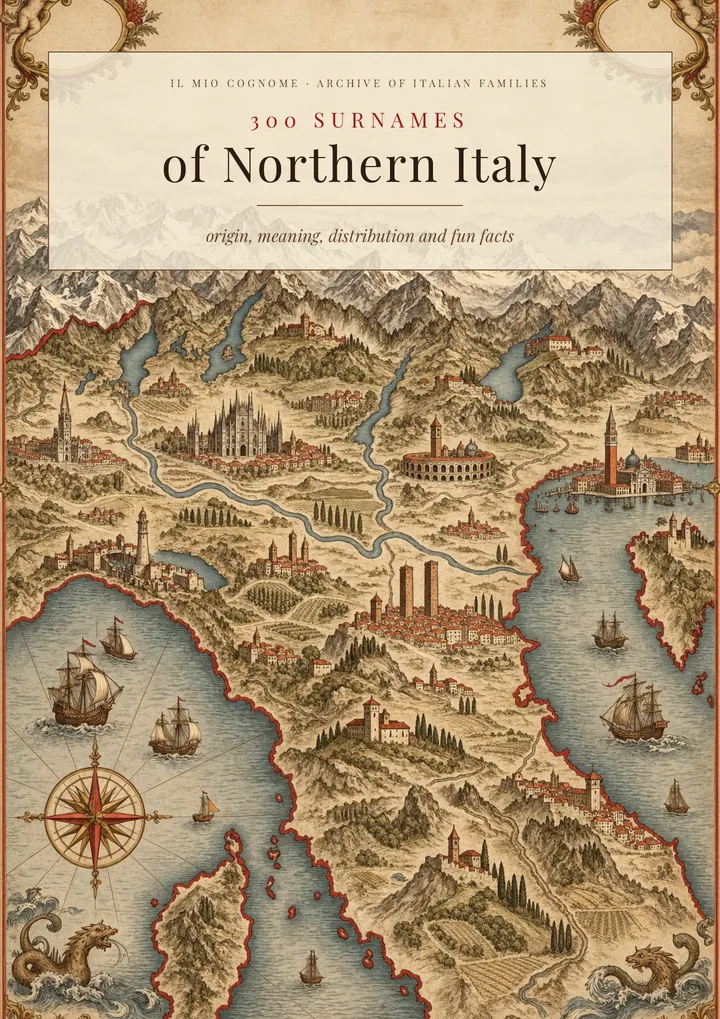
Surnames of Northern Italy
300 surnames · €19.90
Buy · €19.90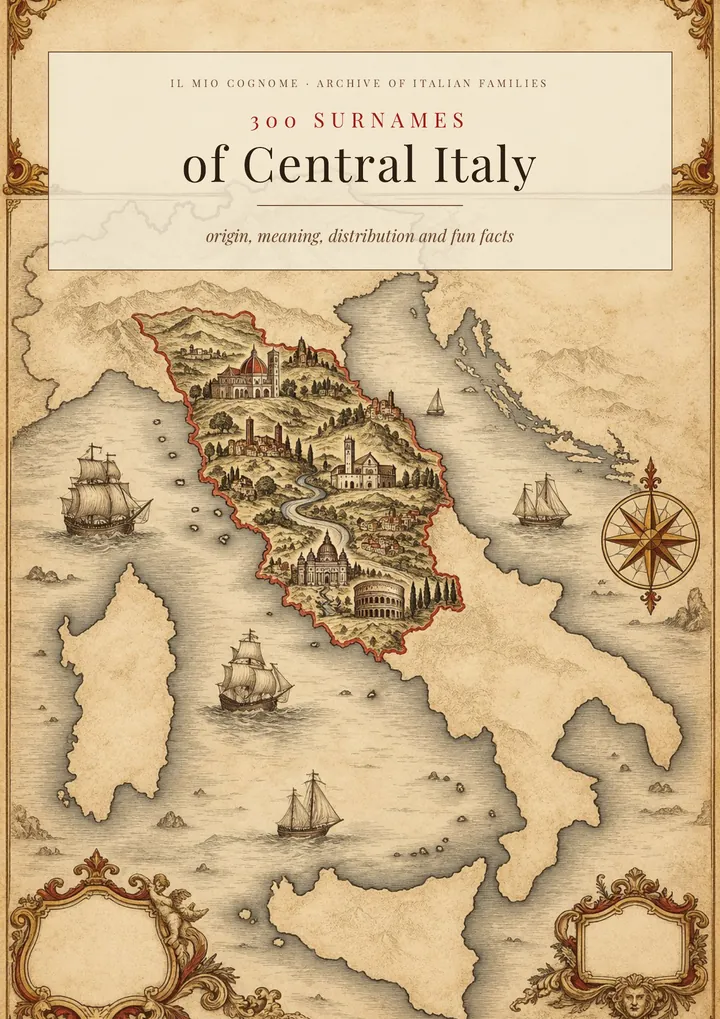
Surnames of Central Italy
300 surnames · €19.90
Buy · €19.90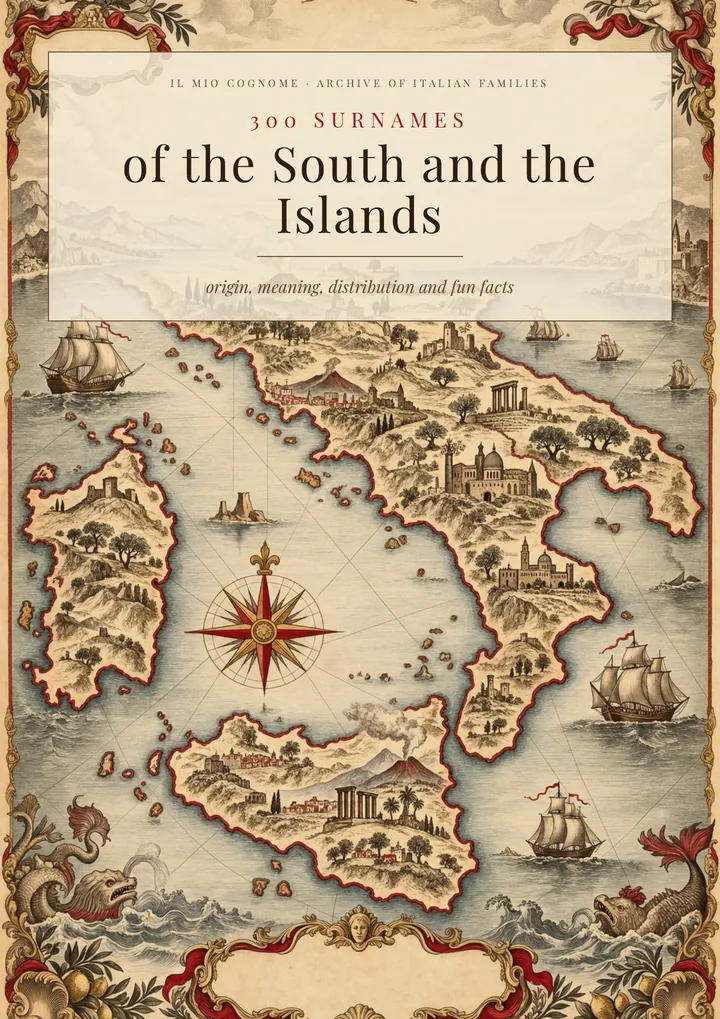
Surnames of the South and the Islands
300 surnames · €19.90
Buy · €19.90Want to know where your surname comes from? Look it up in the catalog or explore the volumes by area of Italy.