
Sicily’s surnames, people by people
In 734 BC the Greeks founded Naxos, below Taormina, and for more than a thousand years Greek remained the language of church and village. From there come surnames that are names of cities, saints and trades: Trapani, for example, comes from drépanon, the sickle. And from the Greek rite, with its married priests, come Privitera, the priest’s wife, and Iacono, the deacon.
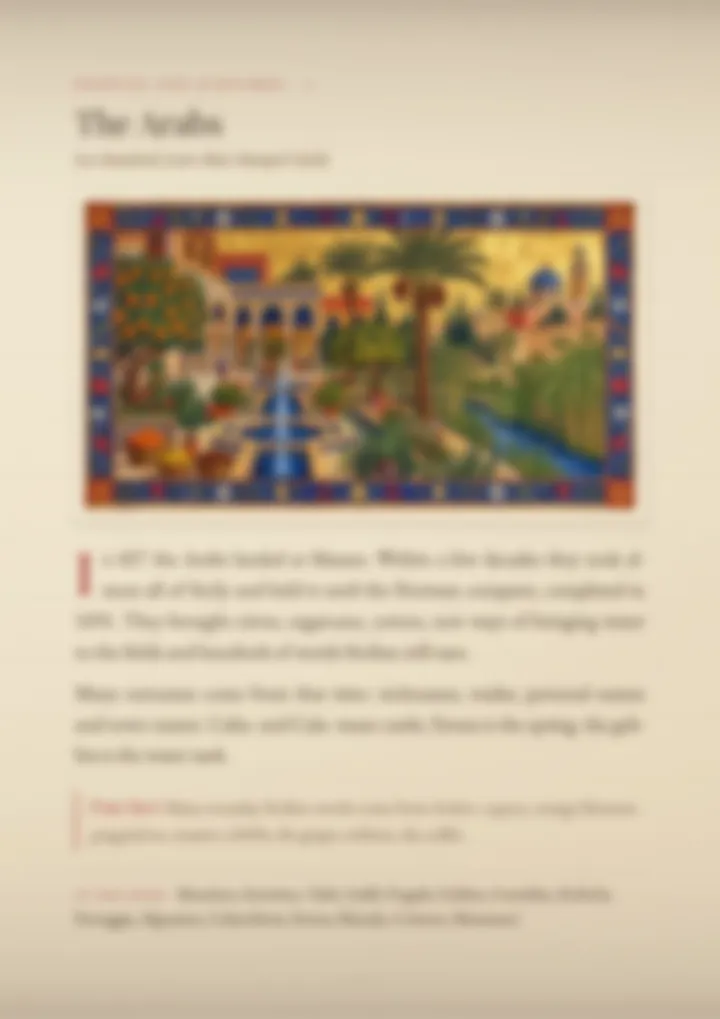
Then the others arrived. The Arabs, who landed at Mazara in 827, left citrus fruit, sugar cane and hundreds of words: Calta- means castle, Favara is the spring, the gebbia is the water tank. With the Normans, who made Palermo the capital of a kingdom, came names like Malgerio, the source of Maugeri, and the settlers from the North whom Sicilians called “lombardi”: from them comes Lombardo. Four centuries of Aragon and Spain added Catalano and Maiorca, and in the ports of Messina, Palermo and Trapani whoever stayed became, to the neighbors, “the Genoese” or “the Maltese.”
The volume gives a chapter to each of these eleven peoples and stories, and for each one it lists the surnames in the book that carry its mark.
How to recognize a Sicilian surname
Some signs are easy to spot. The article in front, Lo, La, Li, is typical of the island: Lo Presti, La Rosa, Lo Giudice. Di means “son of”: Di Stefano, Di Mauro. The accent at the end, as in Calì, Patanè and Zappalà, is often a clue to a Greek or Arabic word. And many surnames are towns, because whoever left Licata or Modica became, in the new town, “Licata” or “Modica.”
Province by province
At the back of the volume an index gathers, province by province, the surnames that weigh most there: 197 surnames from the book, spread across the nine provinces from Agrigento to Trapani. Then comes the list of the 77 Sicilian towns where a surname from the book is the most common: in Palermo, for example, No. 1 is the name of another city on the island.
Is your surname in the volume?
Type it below: we'll tell you right away if it's there, and in which volume.
- Abbate
- Adamo
- Agnello
- Agosta
- Aiello
- Alaimo
- Alessi
- Amato
- Arcidiacono
- Arena
- Barbagallo
- Barbera
- Barone
- Basile
- Battaglia
- Biondo
- Bonanno
- Bono
- Bruno
- Burgio
- Calabrese
- Calì
- Cammarata
- Campisi
- Campo
- Cannata
- Cannizzaro
- Cappello
- Caruso
- Cascio
- Castiglione
- Catalano
- Catania
- Cavallaro
- Cicero
- Coco
- Consoli
- Conti
- Cosentino
- Costa
- Costantino
- Costanzo
- Cottone
- Cusumano
- D’Amico
- D’Angelo
- D’Anna
- De Luca
- Di Bella
- Di Benedetto
- Di Dio
- Di Gregorio
- Di Maggio
- Di Marco
- Di Maria
- Di Martino
- Di Mauro
- Di Pietro
- Di Salvo
- Di Stefano
- Drago
- Failla
- Fazio
- Ferrante
- Ferrara
- Ferraro
- Ferro
- Fichera
- Finocchiaro
- Fontana
- Foti
- Furnari
- Gagliano
- Gallo
- Garofalo
- Genovese
- Gentile
- Geraci
- Giacalone
- Giannone
- Giardina
- Giordano
- Giuffrida
- Giuliano
- Giunta
- Grasso
- Greco
- Grillo
- Gulino
- Iacono
- Indelicato
- La Barbera
- Lanza
- La Rocca
- La Rosa
- Lentini
- Leonardi
- Leone
- Leotta
- Licata
- Licciardello
- Lipari
- Lo Giudice
- Lombardo
- Longo
- Lo Presti
- Lupo
- Macaluso
- Maggio
- Maltese
- Mancuso
- Mangano
- Maniscalco
- Mannino
- Marchese
- Marino
- Marletta
- Martorana
- Maugeri
- Mazzola
- Meli
- Messina
- Miceli
- Migliore
- Milazzo
- Militello
- Mineo
- Modica
- Montalbano
- Motta
- Musumeci
- Napoli
- Occhipinti
- Orlando
- Pace
- Pagano
- Palazzolo
- Palermo
- Palmeri
- Palumbo
- Pappalardo
- Parisi
- Patanè
- Patti
- Pecoraro
- Pellegrino
- Pennisi
- Petralia
- Piazza
- Pipitone
- Pizzo
- Platania
- Polizzi
- Privitera
- Puccio
- Puglisi
- Pulvirenti
- Raciti
- Ragusa
- Randazzo
- Rapisarda
- Rizza
- Rizzo
- Romano
- Romeo
- Rubino
- Ruggeri
- Russo
- Salemi
- Salvo
- Sanfilippo
- Santangelo
- Santoro
- Sapienza
- Schillaci
- Sciacca
- Sciortino
- Scuderi
- Sorbello
- Sottile
- Spadaro
- Spampinato
- Spina
- Strano
- Terranova
- Todaro
- Torre
- Torrisi
- Toscano
- Trapani
- Urso
- Vaccaro
- Valenti
- Vassallo
- Vecchio
- Vella
- Ventura
- Vinci
- Vitale
- Zappalà
- Abbruzzo
- Accetta
- Agate
- Agugliaro
- Alescio
- Algozzino
- Alosi
- Aquilina
- Arcoleo
- Attardo
- Avola
- Badalamenti
- Baglio
- Blandini
- Blunda
- Bongiovi
- Buemi
- Cafari
- Caico
- Calandrino
- Calascibetta
- Caldarella
- Cancemi
- Cardaci
- Carrubba
- Casablanca
- Cassisi
- Castriciano
- Catalfamo
- Catanese
- Ciurcina
- Colletti
- Cristodaro
- Curatolo
- Dino
- Di Noto
- Donia
- Enea
- Farruggia
- Favara
- Fiandaca
- Fiorello
- Fragalà
- Fricano
- Galifi
- Gambina
- Gangi
- Gebbia
- Geloso
- Gemellaro
- Giaramita
- Giarratano
- Graci
- Granvillano
- Guttuso
- Incorvaia
- Indovino
- Ingraffia
- La Greca
- Latina
- Leggio
- Levantino
- Liberto
- Lo Castro
- Lo Cicero
- Lo Nardo
- Lumia
- Maiorca
- Mallo
- Mangiapane
- Marsala
- Pizzurro
- Pluchino
- Prestifilippo
- Prestigiovanni
- Provenzani
- Ravì
- Realmuto
- Rindone
- Salvia
- Sanclemente
- Sciarratta
- Scicolone
- Sclafani
- Seidita
- Solarino
- Spiteri
- Stornello
- Sturiale
- Taibi
- Tirenni
- Trusso
- Turdo
- Tusa
- Tuttobene
- Vigneri
- Virga
- Viscuso
- Zambuto
- Zichichi
Surnames in red also have their own booklet.
FAQ
Is my surname in the volume?
The full list of the 300 surnames is on this page. If yours isn’t there, request it through our contact page: new booklets come from the most requested surnames.
How is it different from the volume on the South and the Islands?
The South volume picks 300 surnames from eight regions. This one is devoted to Sicily alone: eleven chapters on the island’s peoples and stories and, when there is one, each surname’s Sicilian record. 151 surnames are in both: the other 149 you’ll find only here.
Will I find the surnames of my province?
At the back of the volume an index gathers, province by province, the surnames that weigh most there: 197 surnames from the book, spread across the nine provinces from Agrigento to Trapani. There’s also the list of the 77 Sicilian towns where a surname from the book is the most common.
What’s the difference between the volume and a surname booklet?
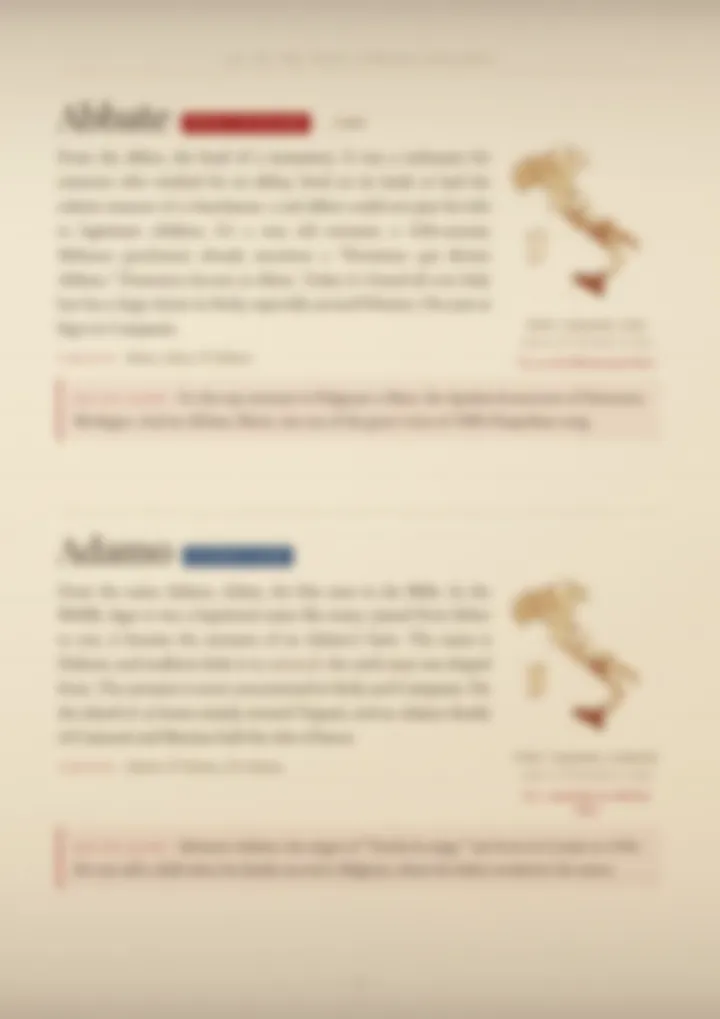
In the volume each surname has a half-page entry: origin, map, variants and a fun fact. The booklet is devoted to a single surname and tells its story, its towns and its distribution in 12-19 pages, with a family tree and a scroll made out to that surname.
Does the volume tell me who my ancestors were?
No. A surname tells you where a word comes from, and two families with the same surname can have completely different stories. At the back of the volume there’s a guide to start searching for your ancestors in the archives, free and from home, with tips for Sicily, where civil registration began in 1820.
Does the volume include my surname’s coat of arms?
No, because a surname has no coat of arms: a coat of arms belonged to one specific branch of a family, not to everyone who carries the surname. When a fun fact mentions one, the entry says which family it belonged to.
What if scholars disagree about the origin?
We tell you. When an origin is certain, it’s written as certain; when it isn’t, the entry carries the gray “disputed origin” badge and gives you the theories.
Can I print it?
Yes, for personal and family use: you can print it for yourself and your relatives.


