
Where the Greco surname comes from
Greco is one of the most transparent surnames in Italy. It comes from the medieval name Greco, from the Latin graecus: “born in Greece,” “come from Greece.” In all likelihood it marked the origin of the founder. It could also be a nickname for someone who resembled a Greek, in looks or in character.
In the South, though, “Greek” didn’t necessarily mean foreign. For centuries Greek was spoken in Apulia, Calabria and Sicily. The Greco could be the neighbor who spoke another language.
Three thousand years of Greek in the South
Long before surnames, the South already spoke Greek. There were two great waves, centuries apart, over the same lands. And there are towns where the elderly still speak a Greek dialect today. The PDF tells which towns, and who the monks were who left painted churches in the rock.
Where the Grecos live today
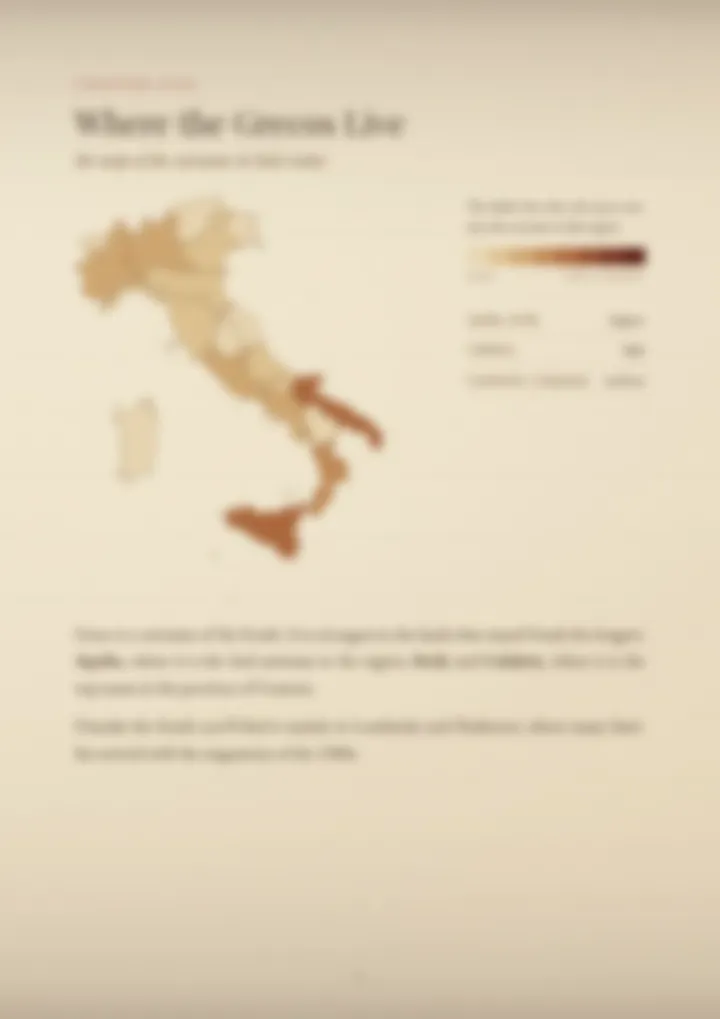
Greco is a surname of the South: there are about 21,500 families in Italy. It is very strong in the lands that stayed Greek the longest. In Apulia it is the region’s second most common surname, and it is very common in Sicily and Calabria. In the province of Cosenza it is the top surname, and the town where it ranks first is Mendicino. In the North you find it mostly in Lombardy and Piedmont, where many families arrived in the 1900s. The region-by-region map and the countries around the world where the Grecos settled are in the PDF.
Variants
The same people gave rise to different forms from one region to the next, with the dialect’s vowel, in the plural or with the article. The PDF explains where each one comes from.
| Surname | Where it is concentrated |
|---|---|
| Greco | Apulia, Sicily, Calabria |
| Grieco | Campania, Basilicata, Apulia |
| Greci | Lazio, Emilia-Romagna, Sicily |
| Del Greco | Lazio, Abruzzo, Tuscany |
FAQ
What does the Greco surname mean?
It comes from the Latin graecus, “the Greek.” It marked someone who came from Greece, or it was a nickname for someone who resembled a Greek, in looks or in character.
Is Greco a surname from Apulia, Calabria or Sicily?
All three. It is the second most common surname in Apulia and the top surname in the province of Cosenza, and it is also very common in Sicily. It reached the North mostly with the emigration of the 1900s.
Do people named Greco have ancestors in Greece?
Not necessarily. For centuries Greek was spoken in the South, in monasteries, villages and ports. The surname could mark a local family that spoke Greek or followed the rite of the Eastern Church.
Are Greco and Grieco the same surname?
Yes, they have the same origin. Grieco is the form used in Campania and Basilicata, with the dialect’s vowel. Until the 1800s the surname was written down by whoever kept the register, often the way he heard it pronounced: in the archives it’s best to search for every form.
Are all Grecos related?
No. The surname was born in many different places, from families with no connection to one another. To rebuild your own family history you need birth records and parish registers.
Is the Greco surname noble?
The surname itself doesn’t mean nobility. It was borne by families from every walk of life: farmers, fishermen, craftsmen, monks. Nearly all of them never had a coat of arms.
Is there a Greco family coat of arms?
Individual Greco families had coats of arms, for example one from Palermo and Acireale. They belonged to that branch, not to the twenty thousand Greco families of today. There is no single coat of arms for all Grecos.


