
Apulia’s surnames, people by people
Before the Greeks and the Romans, Apulia was the land of the Iapygians: the Daunians around Foggia, the Peucetians in the Bari area, the Messapians in the Salento. The Romans called it Apulia, and from there comes the surname Pugliese. Taranto, founded according to tradition by settlers from Sparta, was one of the richest cities of Magna Graecia, and Greek never fully died out here: in the towns of the Grecìa Salentina the elderly still speak Griko. From that language come Calò, Chiriatti, Petrachi, Polimeno.
Then the others arrived. The Lombards made the cave of Saint Michael, on the Gargano, their sanctuary; Bari became the capital of Byzantine Italy. In 1087 sailors from Bari brought the bones of Saint Nicholas to the city, and Nicola became one of the best-loved names in Apulia: from Cola, its short form, come Colella and Colazzo. Frederick II, the “boy of Apulia,” moved thousands of Muslims from Sicily to Lucera, and their memory lives on in surnames like Saracino. With the Angevins came the Provençals of the Monti Dauni, from across the Adriatic Albanians and Slavs, and with the viceroys of Naples the Spanish.
The volume gives a chapter to each of these eleven peoples and stories, and for each one it lists the surnames in the book that carry its mark.
How to recognize an Apulian surname
Some signs are easy to spot. Around Bari the article got attached to the surname: Lorusso, Losito, Loconte, Labianca. In the Salento De dominates: De Giorgi, De Pascalis, De Santis. Many surnames are names of Apulian towns, like Altamura, Monopoli, Putignano, Rutigliano, and many end in -uzzi and -ulli, the local diminutives: Giannuzzi, Amatulli, Ferrulli. And the final -is of Iacobellis and Miccolis is the Latin of the registers, still attached to the name.
Province by province
At the back of the volume an index gathers, province by province, the surnames that weigh most there: 218 surnames from the book, spread across the six provinces from Bari to Taranto. Then comes the list of the 61 Apulian towns where a surname from the book is the most common: in Bari, for example, No. 1 is Lorusso, with the article attached.
Is your surname in the volume?
Type it below: we'll tell you right away if it's there, and in which volume.
- Acquaviva
- Albanese
- Albano
- Altamura
- Amato
- Amoruso
- Ancona
- Antonacci
- Barletta
- Barone
- Basile
- Battista
- Bello
- Berardi
- Bianco
- Binetti
- Blasi
- Bruno
- Bucci
- Calabrese
- Calò
- Campanale
- Campanella
- Cannone
- Capone
- Caputo
- Caramia
- Carbonara
- Carbone
- Carella
- Carlucci
- Carluccio
- Carone
- Carrieri
- Carrozzo
- Cassano
- Castellano
- Catalano
- Cavallo
- Cazzato
- Centonze
- Ciavarella
- Clemente
- Colella
- Colonna
- Colucci
- Conte
- Coppola
- Curci
- D’Agostino
- D’Alessandro
- D’Amato
- D’Ambrosio
- D’Amico
- De Carlo
- De Giorgi
- D’Elia
- Dell’Anna
- De Luca
- Del Vecchio
- De Marco
- De Matteis
- De Palma
- De Pascalis
- D’Errico
- De Santis
- Di Bari
- Di Gioia
- Di Leo
- Elia
- Epifani
- Errico
- Esposito
- Falcone
- Fanelli
- Fasano
- Ferrante
- Ferrara
- Fiore
- Fiorentino
- Forte
- Fortunato
- Franco
- Gallo
- Gentile
- Giannuzzi
- Gigante
- Giordano
- Giuliani
- Grassi
- Grasso
- Greco
- Guerra
- Guglielmi
- Guida
- Ingrosso
- Laterza
- Leo
- Leone
- Ligorio
- Lippolis
- Liuzzi
- Lombardi
- Longo
- Lorusso
- Losito
- Macchia
- Maggi
- Maggio
- Maiorano
- Manca
- Mancini
- Manco
- Marangi
- Mariano
- Marinelli
- Marino
- Marra
- Martella
- Martina
- Martino
- Marzo
- Massaro
- Matera
- Mazzotta
- Mele
- Miccoli
- Miglietta
- Monaco
- Mongelli
- Monopoli
- Montanaro
- Orlando
- Pace
- Pagano
- Pagliara
- Palazzo
- Palma
- Palmieri
- Palmisano
- Palumbo
- Panico
- Paparella
- Paradiso
- Parisi
- Pastore
- Patruno
- Pellegrino
- Pepe
- Perrone
- Petrelli
- Pinto
- Potenza
- Prencipe
- Pugliese
- Putignano
- Ranieri
- Renna
- Resta
- Ricci
- Rinaldi
- Rizzello
- Rizzi
- Rizzo
- Rollo
- Romano
- Rosato
- Rubino
- Ruggieri
- Ruggiero
- Russo
- Rutigliano
- Santoro
- Saponaro
- Saracino
- Sasso
- Savino
- Scarano
- Schiavone
- Scialpi
- Semeraro
- Serio
- Spagnolo
- Spedicato
- Spinelli
- Stefanelli
- Tarantino
- Todisco
- Toma
- Tondo
- Totaro
- Tricarico
- Urso
- Valentini
- Ventura
- Vinci
- Vitale
- Volpe
- Zaccaria
- Zecca
- Accogli
- Aghilar
- Amatulli
- Antenozio
- Armenise
- Baldaro
- Bellanova
- Bottalico
- Bramato
- Buccoliero
- Buonpensiero
- Cagnazzo
- Calamita
- Caliandro
- Calogiuri
- Caponio
- Carbotti
- Castrignano
- Chimienti
- Chiriatti
- Ciardo
- Ciccarese
- Ciciriello
- Cinquepalmi
- Civita
- Colazzo
- Colizzi
- Convertini
- Convertino
- Corvaglia
- Cupertino
- Dibenedetto
- Donno
- Favia
- Ferrulli
- Francioso
- Giannoccaro
- Giorgino
- Gorgoglione
- Iacobellis
- Ieva
- Imperio
- Intini
- Labianca
- Ladisa
- Laghezza
- Lanotte
- Lauriola
- Lecce
- Lenoci
- Liso
- Loconte
- Locorotondo
- Loiudice
- Loparco
- Losurdo
- Manigrasso
- Mannarini
- Manzari
- Marzulli
- Massafra
- Matarrese
- Miccolis
- Montinaro
- Montrone
- Moramarco
- Morciano
- Morleo
- Motolese
- Muci
- Natola
- Nestola
- Netti
- Ninni
- Padalino
- Pennetta
- Petrachi
- Piccinno
- Pichierri
- Polieri
- Polimeno
- Quartulli
- Raguso
- Raho
- Rampino
- Ricchiuto
- Scardigno
- Schirinzi
- Schirone
- Schito
- Sgaramella
- Signorile
- Soldano
- Specchia
- Susca
- Tanzarella
- Tatullo
- Tramacere
- Tundo
- Zizzi
Surnames in red also have their own booklet.
FAQ
Is my surname in the volume?
The full list of the 300 surnames is on this page. If yours isn’t there, request it through our contact page: new booklets come from the most requested surnames.
How is it different from the volume on the South and the Islands?
The South volume picks 300 surnames from eight regions. This one is devoted to Apulia alone: eleven chapters on the region’s peoples and stories and, when there is one, each surname’s Apulian record. 83 surnames are in both: the other 217 you’ll find only here.
Will I find the surnames of my province?
At the back of the volume an index gathers, province by province, the surnames that weigh most there: 218 surnames from the book, spread across the six provinces from Bari to Taranto, Barletta-Andria-Trani included. There’s also the list of the 61 Apulian towns where a surname from the book is the most common.
What’s the difference between the volume and a surname booklet?
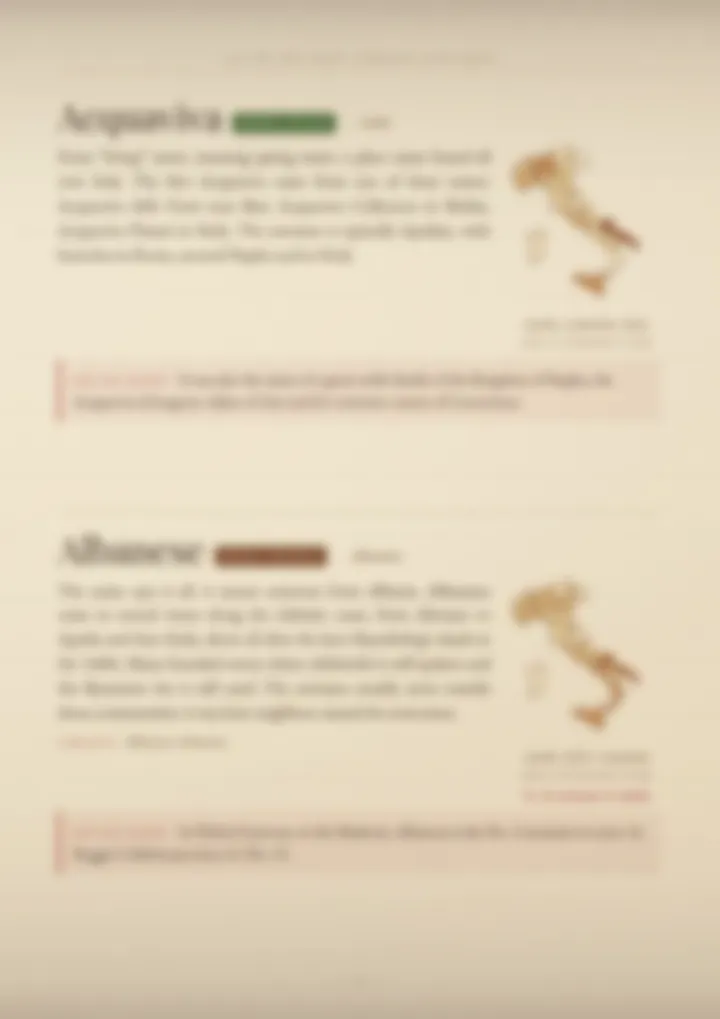
In the volume each surname has a half-page entry: origin, map, variants and a fun fact. The booklet is devoted to a single surname and tells its story, its towns and its distribution in 12-19 pages, with a family tree and a scroll made out to that surname.
Does the volume tell me who my ancestors were?
No. A surname tells you where a word comes from, and two families with the same surname can have completely different stories. At the back of the volume there’s a guide to start searching for your ancestors in the archives, free and from home.
Does the volume include my surname’s coat of arms?
No, because a surname has no coat of arms: a coat of arms belonged to one specific branch of a family, not to everyone who carries the surname. When a fun fact mentions one, the entry says which family it belonged to.
Can I print it?
Yes, for personal and family use: you can print it for yourself and your relatives.


