October 1, 2026 · 6 min read
How to Find the Origin of Your Italian Surname
Every Italian surname was born to tell one person apart from another. In a medieval village there might be three men named Giovanni, and people needed to know which one they meant. So they said “Giovanni di Martino,” “Giovanni il Lungo” (the tall one), “Giovanni di Butera.” Over time that second name passed to the children, and it became the family name.
Finding the origin of your surname means going back to that first nickname. Here’s how, in five steps.
1. Work out which family of surnames it belongs to
Almost all Italian surnames come from five sources. Recognizing yours is the first step.
The father’s name
This is the most common source. Di Martino means “son of Martino.” Basile comes from the Greek name Basil, “royal.” Leone and Leo were personal names, given as a wish for strength and courage.
A place
Someone who moved away became, for the new neighbors, “the one from Catania” or “the one from Licata.” That’s why a place surname is usually born outside that place: in the city itself, everyone was from Catania. The same goes for Butera, Randazzo, and Romano. Romano could mean someone from Rome, but also from towns like Romano Canavese or Romano d’Ezzelino.
A trade
Scuderi comes from the squire, the helper who carried a knight’s shield. The name stayed with the family long after the trade had disappeared.
A nickname
Bruno was someone with dark hair. Longo was the tallest man in the village. Grasso, “fat,” was almost a compliment when hunger was a constant guest: it meant sturdy and healthy.
A good wish
In the Middle Ages many names were good wishes for a newborn. Bonanno means “good year.” Giunta comes from Bonagiunta, the “good addition” to the family.
2. Be wary of the most obvious explanation
The meaning that seems obvious is often wrong. Pagano sounds like “pagan,” but it comes from the Latin paganus, the man of the village, and in the Middle Ages it was an ordinary personal name. Aiello looks like any other surname, yet it comes from agellum, the “little field.”
Sometimes there are two possible paths, and no document says which one is right. Rapisarda might come from “apri sarde,” the sardine-opener, a name for someone who cleaned and sold fish. Or from rapa, “to snatch.” A serious etymology says so, instead of picking one at random.
3. Look at where it’s concentrated today
Where a surname lives today says a lot about where it was born. For centuries families stayed in the same town, generation after generation. Rapisarda was born in the area around Catania, and that’s still where it’s concentrated. Giunta has its heart in Sicily today, but it also has old roots around Pesaro, Lucca, Milan, and Turin.
Sometimes the map is surprising. Leone has its heart in Apulia and Sicily, but the town where it ranks first is Rivarolo Canavese, near Turin. It was most likely brought there by the trains of the 20th century, when southern Italians moved north for work. That’s why a presence in the North often tells a story of recent migration.
The map is useful for something else too. A surname found all over Italy was born more than once, in different places. A rare surname, concentrated in a few towns, is more likely to have a single origin.
4. Follow the variants
The same surname is often spelled in different ways. Aiello and Ajello are the same word. Until the 1800s, the surname was written by whoever kept the register, and j was the old spelling of i. Scuderi is the Sicilian form, Scudieri the one from Campania. Prepositions matter too: Di Martino and De Martino were interchangeable for centuries, and around Ragusa the surname fused into Dimartino.
Sometimes only the final vowel changes. Bonanni is the plural form of Bonanno, born mostly in central Italy. Variants tell where a surname traveled and how people pronounced it in each town.
If your family emigrated, the spelling may have changed again abroad. Not at Ellis Island, despite the family stories: officials there checked each arrival against the passenger list drawn up at the port of departure. The changes usually came later, often made by the immigrants themselves or their children, on school, work, or naturalization papers. The Italian spelling is the one to look for in Italian records.
5. Tell the surname apart from your family
This is where the most common mistake happens. The origin of the surname tells you where the name comes from, while the story of your family is a different search.
A surname born more than once has many different founders. Two Bonannos from distant towns are most likely not related. To know which line you descend from, you need documents: civil registration records on the Portale Antenati and parish registers. If your family emigrated, add the records of the country they arrived in. From the Council of Trent, which closed in 1563, parishes had to record baptisms and marriages.
The two searches go together. The origin of the surname tells you what to look for, and the documents tell you whether it’s really about you.
Where to start
If your surname is one of those we’ve written about, the booklet gives you the whole journey. You’ll find the meaning and origin, the map in Italy and around the world, the variants when there are any, and the famous people who carried it. At the back there’s a guide to the first steps in searching for your ancestors, free and from home, with a family tree to fill in.
If you’d like to know the surnames of relatives and friends too, our three volumes gather hundreds of them, by area of Italy. Each surname has its own entry: origin, meaning, where it lives today, and a fun fact.
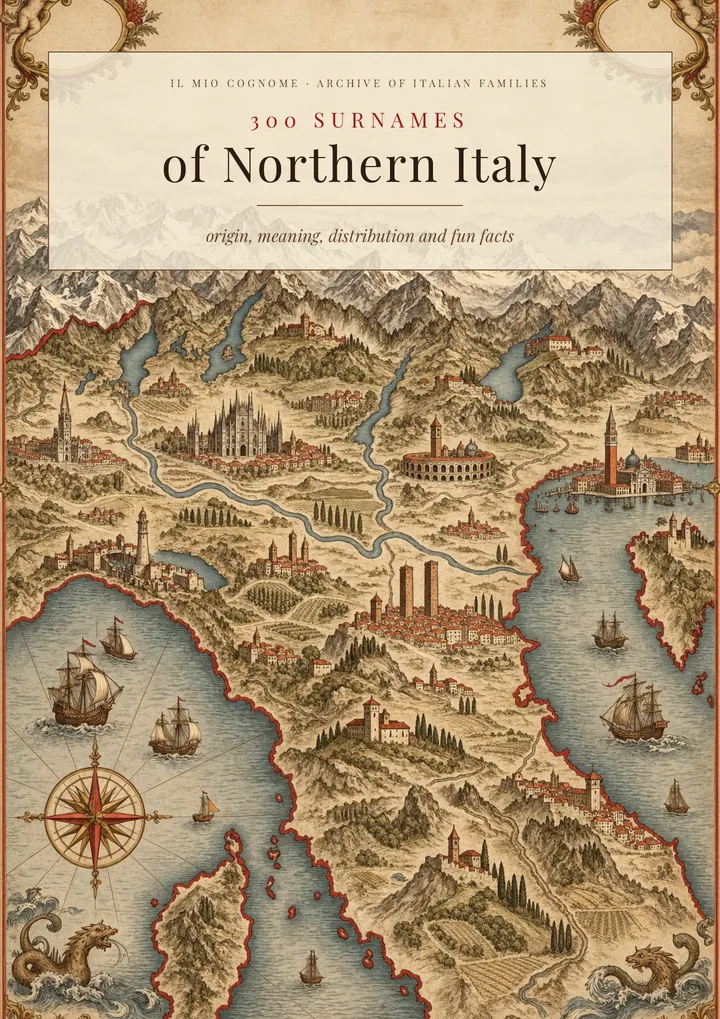
Surnames of Northern Italy
300 surnames · €19.90
Buy · €19.90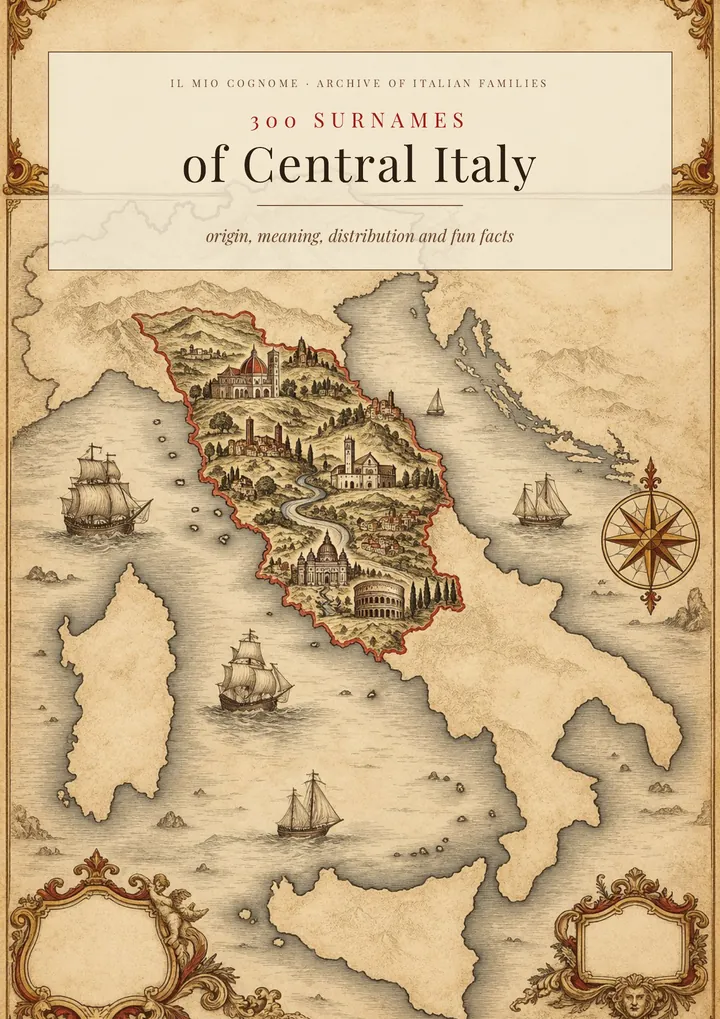
Surnames of Central Italy
300 surnames · €19.90
Buy · €19.90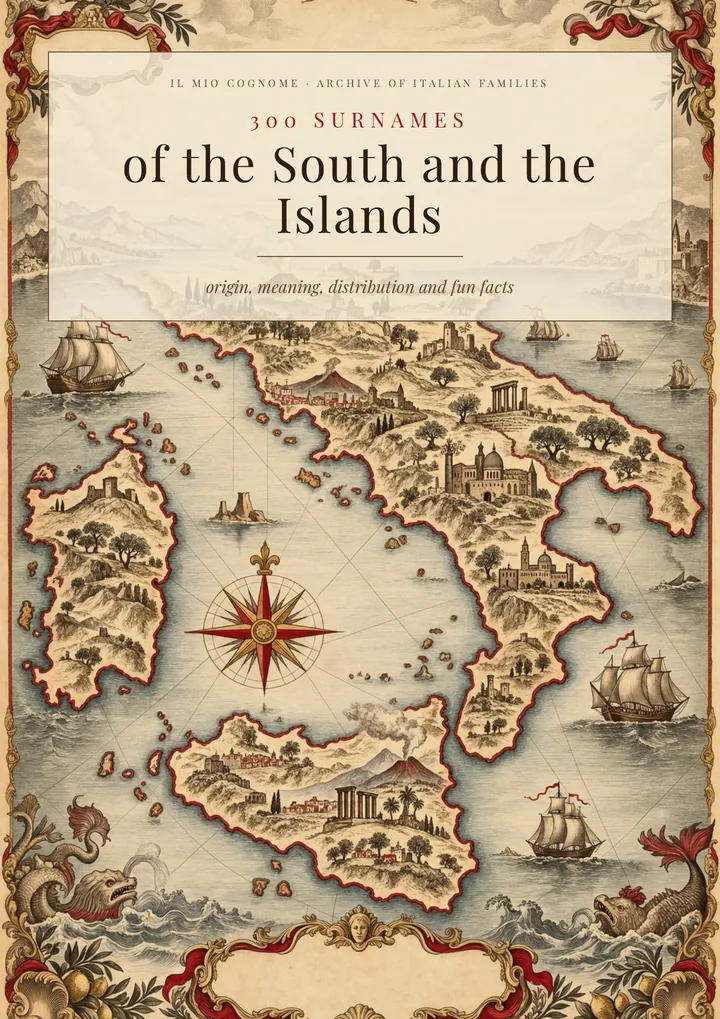
Surnames of the South and the Islands
300 surnames · €19.90
Buy · €19.90Want to know where your surname comes from? Look it up in the catalog or explore the volumes by area of Italy.