October 1, 2026 · 6 min read
Sicilian Surnames and Where They Come From
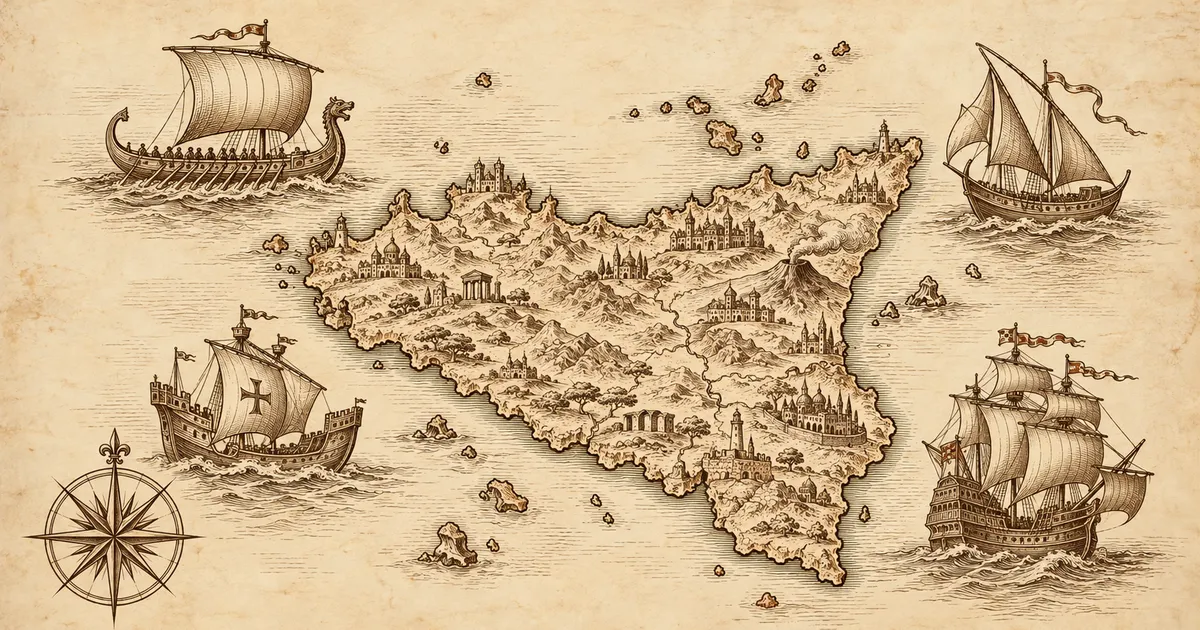
Sicily sits in the middle of the Mediterranean, and sooner or later everyone who crossed that sea stopped there. Greeks, Arabs, Normans, Spaniards: each brought their own language. When surnames appeared, after the year 1000, people used the words they had on their lips. That’s why a Sicilian surname is a small piece of the island’s history.
Here’s where they come from, starting with the Greeks.
Which Sicilian surnames come from Greek?
Southern Italy spoke Greek before it spoke Italian. The Byzantine Empire ruled Sicily until the Arabs arrived, and in many towns Greek remained the everyday language.
Basile comes from the Greek name Basíleios, Basil, “royal.” It was the name of Saint Basil, father of the monks of the East. Messina has a Greek name too, Messéne.
Then there’s the Greek rite, in which priests could marry. Privitera comes from presbytéra, the priest’s wife. Almost nine out of ten Priviteras live in Sicily, mostly around Catania. Lo Presti, on the other hand, comes from the Old French prestre, “priest,” but it too recalls a family tied to a priest.
Which Sicilian surnames come from Arabic?
In 827 the Arabs landed at Mazara. They held the island until 1091, when the Normans took the last stronghold, Noto. They brought citrus fruit, sugar cane, and new ways of bringing water to the fields. They also left hundreds of words that Sicilian still uses.
Some surnames come from there. Morabito comes from murābiṭ, the holy man who preached. Taibi comes from ṭayyib, “good.” Fragalà from Faraḥ Allāh, “joy of God.” Zichichi was the seller of skins for water and wine. For Musumeci the most likely explanation is Arabic, but scholars still debate it.
Very often, though, Arabic reaches the surname by way of a town. Calta- and Cala- mean castle: hence Calascibetta. Favara is the spring. Butera meant “the one from Butera,” the clifftop town above Gela. And the town’s name comes from the Arabic Bū tīrah, “steep place.” So a surname can be Arabic without the person who carried it being Arab.
Watch out for the opposite case too. Giacalone is the most common surname in Mazara del Vallo, the city where the Arabs landed in 827. Yet it doesn’t come from Arabic: it’s a “big Giacomo,” or a place near Monreale.
What did the Normans and Spaniards leave behind?
The Normans landed at Messina in 1061. In 1130 Roger II was crowned king in Palermo. With them came personal names from northern Europe. The name Godfrey, Goffredo in Italian, became Giuffrida in Sicilian. Mauger, the name of a son of Tancred of Hauteville, became Maugeri.
In their wake came settlers from northern Italy, whom Sicilians called “Lombards.” Lombardo almost always comes from them, and today it’s the fourth most common surname in Sicily. The name Aiello already appears at the Norman court.
After the Sicilian Vespers of 1282, Sicily passed to the Crown of Aragon. Then came the viceroys of Spain, until 1713. Over four centuries, nobles, soldiers, and merchants from Catalonia and Majorca landed on the island. Many Spanish surnames became so Italianized that they’re no longer recognizable. Others still tell where they came from: Catalano, Maiorca.
Why do so many Sicilians carry the name of a town?
Someone who moved away became, for the new neighbors, “the one from Catania” or “the one from Licata.” The name then passed to the children. That’s why a town surname is usually born far from the town: there, everyone was from Catania.
Today’s map confirms it. The surname Messina, for example, is most common in Palermo. Randazzo comes from the town below Mount Etna, but its center is in the province of Palermo. Sciacca, Milazzo, Patti, and Ragusa were born the same way. Puglisi is “Apulian” in Sicilian: the first one had arrived from Apulia.
How do you recognize a Sicilian nickname?
Many surnames were born from village gossip. Pappalardo was the “lard eater,” someone who didn’t keep the fast. Rapisarda might have been someone who opened sardines, or someone who stole them. Grasso, “fat,” meant sturdy, almost a compliment.
Then there’s a sign you can spot right away: the article in front. La Rosa, Lo Presti, Lo Bianco. In Sicily the article was often placed before a nickname or before the mother’s name. Next to the nicknames there are the good wishes: Bonanno means “good year.”
Does your surname tell you which people you descend from?
No, and this is where people often go wrong. The surname tells you the language of a word. Your ancestors are another story. A Morabito doesn’t necessarily have Arab ancestors: by then murabitu was a dialect word, “moderate, well-behaved,” and any neighbor could have given the nickname.
It works the other way around too. In 1492 an edict expelled the Jews from Sicily, and those who stayed had to convert. Converts usually took common Christian surnames. That’s why there are no Sicilian surnames that are certainly Jewish, and anyone who gives you a list is wrong.
The origin of the surname tells you where the name comes from. To know where your family comes from, you need civil registration and parish registers. If your family emigrated, add the records of the country where they arrived.
Where to start
If your surname is one of those we’ve written about, the booklet gives you its origin, map, variants, and famous bearers. If you’d also like to discover those of relatives and friends, the volume on the South gathers three hundred of them.
Want to know where your surname comes from? Look it up in the catalog or explore the volumes by area of Italy.