Surnames of Sicily · Volume 2
origin, meaning, distribution and fun facts
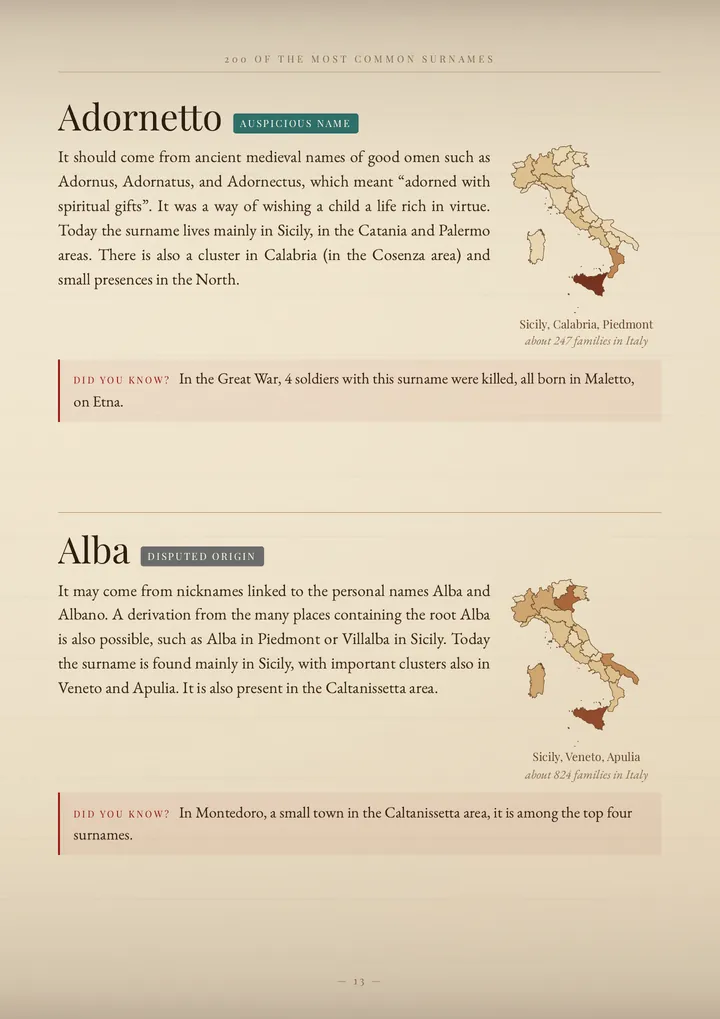


€19.90 Instant PDF · 175 pages
Buy the volumeGuaranteed PDF: if it won't open or has a fault, we'll fix itPay by card on Payhip, secured by Stripe
- Instant PDF, and the link also arrives by email
- In Italian and English: you get both versions
- A4 format: read it on your phone or print it
The first volume of Sicilian surnames did better than we hoped, and many of you wrote to us with the same words: “my surname wasn’t there.” This second volume gathers 300 new surnames, none of them in the first one.
You’ll find 200 carried by hundreds or thousands of Sicilian families, from Agrigento to Messina, from Trapani to Syracuse, and 100 lesser-known ones, some extremely rare, chosen from the ones you asked for in the comments. Some exist in a single town.
- Origin and meaning
- Map of the regions
- Variants
- Fun facts
- Surnames province by province
- Ancestor guide
300surnames
175pages
8history chapters
The volume at a glance
- Surnames
- 300 new: 200 of the most common and 100 lesser-known
- Pages
- 175, in PDF
- Provinces
- Agrigento, Caltanissetta, Catania, Enna, Messina, Palermo, Ragusa, Syracuse, Trapani
- Chapters
- eight: how a surname changes, Greeks, the Greek rite, Arabs, Normans and Swabians, Germanic names, Aragonese and Spanish, merchants and outsiders
What's inside
- For each surname, its origin, its meaning and the language or people it comes from, from Greek to Arabic
- The map of the Italian regions where it’s common today and an estimate of how many families carry it
- The Sicilian record, when there is one, meaning the surname’s rank or the town where it’s No. 1
- The variants, meaning the other forms and spellings of the same surname
- One fun fact per surname, from a town to a historical figure, and in many entries the soldiers killed in the Great War who were born in a town
- Eight chapters, from how a surname changes to the peoples who shaped Sicilian surnames, from the Greeks to the foreign merchants
- The province-by-province index, with the surnames most deeply rooted in each, the towns where they’re No. 1, and two indexes, by origin and alphabetical
- A guide to start searching for your ancestors, a family tree to fill in and a surname scroll

Guaranteed PDF: if it won't open or has a fault, we'll fix itPay by card on Payhip, secured by Stripe
- Instant PDF, and the link also arrives by email
- In Italian and English: you get both versions
- A4 format: read it on your phone or print it
Surnames of Sicily · Volume 2
300 more surnames, all new
After the first volume many of you wrote to us, from Sicily and from every corner of the world where a Sicilian lives. You were looking for your surname and couldn’t find it. This volume starts there: none of its 300 surnames appears in the first book, and many of them you asked for yourselves.
For each one you’ll find where it comes from, what it meant, where it’s found today, the Sicilian town where it is strongest, and a fun fact.
How a surname changes, and the peoples who shaped it
For centuries the people who carried a surname didn’t write it down. The parish priest wrote it in the baptism register, and later the town clerk, who often only heard it spoken. So Saglimbene and Saglimbeni, which probably come from the same good wish, sali bene, “climb well,” are both among the most common surnames in Limina. The same goes for Ceraulo and Ciraolo, for Corrao and Currao, for Ilardi and Ilardo.
Then there are the peoples. Under Byzantium, farmers, fishermen and craftsmen spoke Greek: behind Mastrolembo there may be a boat builder, behind Pittalà a farrier. From the Greek rite comes Chirieleison, which is the prayer “Lord, have mercy” and is found in Alì Terme and Itala. Azzaro, Scandurra and Murabito come from Arabic. The Normans brought Chiaramonte, Germanic names gave Anzelmo and Ridolfo, and Spain gave Avila and Martinez. Mileti, from Mileto, and Seminara are said to come from the name of the town that whole families left when they crossed the Strait.
The volume has eight chapters: one on how surnames change and seven on the island’s peoples and stories. For each one it lists the surnames in the book that carry its mark.
Province by province
At the back of the volume an index gathers, province by province, the surnames most deeply rooted there: 243 surnames from the book, spread across the nine provinces from Agrigento to Trapani. Then comes the list of the 21 Sicilian towns where a surname from the book is the most common: in Limina it’s Saglimbeni, in Gaggi Cundari, in Naso Caliò.
Is your surname in the volume?
Type it below: we'll tell you right away if it's there, and in which volume.
- Adornetto
- Alba
- Aleo
- Alibrandi
- Allegra
- Amodei
- Anello
- Anfuso
- Aparo
- Ardizzone
- Arlotta
- Arno
- Azzaro
- Azzolina
- Baglione
- Baiamonte
- Ballarino
- Balsamo
- Barbarino
- Bartolo
- Baudo
- Bellomo
- Beninati
- Bevacqua
- Bisconti
- Bonasera
- Bonifacio
- Bonura
- Brucculeri
- Brunetto
- Bua
- Bucceri
- Buffa
- Buttà
- Buttafuoco
- Calandra
- Caliò
- Campione
- Caniglia
- Canino
- Cannella
- Capraro
- Caravello
- Casella
- Cataldo
- Celi
- Chiaramonte
- Chimento
- Ciancio
- Cicala
- Cino
- Ciotta
- Ciraolo
- Cirino
- Cocuzza
- Comella
- Corradino
- Corrao
- Corso
- Crupi
- Cundari
- Daino
- D’Antoni
- Di Chiara
- Di Franco
- Di Rosa
- Dolce
- Domina
- Emanuele
- Faraci
- Faraone
- Farinella
- Favaloro
- Ferlazzo
- Fiorenza
- Fiumara
- Fragale
- Freni
- Galluzzo
- Galvagno
- Gangemi
- Gattuso
- Gaziano
- Gelsomino
- Gerbino
- Giacobbe
- Giangreco
- Giarrizzo
- Giganti
- Grigoli
- Grisanti
- Gurgone
- Gusmano
- Ilardi
- Ilardo
- Impellizzeri
- Ioppolo
- Iraci
- Iuculano
- La Corte
- La Mattina
- Landro
- Lazzara
- Leanza
- Leto
- Librizzi
- Lionti
- Litrico
- Liuzzo
- Lo Schiavo
- Maenza
- Magro
- Maiolino
- Maisano
- Manuele
- Marrone
- Martello
- Martinez
- Marullo
- Marzullo
- Matassa
- Mazzù
- Mendolia
- Mileti
- Minissale
- Mino
- Monastero
- Monforte
- Monterosso
- Montesanto
- Morello
- Moschella
- Murabito
- Musco
- Nania
- Naso
- Ottaviano
- Pafumi
- Paino
- Passalacqua
- Pecora
- Pennino
- Pensabene
- Perricone
- Petta
- Picone
- Pisa
- Piscitello
- Pizzuto
- Portaro
- Prestia
- Prestipino
- Priolo
- Profeta
- Proietto
- Restifo
- Ridolfo
- Rini
- Riolo
- Rosano
- Ruvolo
- Saglimbeni
- Salafia
- Salpietro
- Saltalamacchia
- Salvadore
- Sangiorgio
- Santalucia
- Santisi
- Sanzo
- Savarino
- Savoca
- Scandurra
- Scardino
- Scarlata
- Scavuzzo
- Scrivano
- Seminara
- Spatafora
- Spedale
- Speziale
- Spinella
- Stagno
- Surdo
- Terzo
- Tomaselli
- Tomasino
- Tornabene
- Tornatore
- Tosto
- Tramontana
- Tripoli
- Troia
- Turrisi
- Turturici
- Vadalà
- Vasile
- Vicari
- Virgilio
- Zingale
- Acciarito
- Aiuto
- Anzelmo
- Arancio
- Arcodia
- Avila
- Barbagiovanni
- Barbaria
- Barbuscia
- Bellinghieri
- Bellinvia
- Bernardino
- Bonaffini
- Bonforte
- Brancatelli
- Bufalino
- Buoncuore
- Busalacchi
- Cafarella
- Caffarelli
- Caldarera
- Cammaroto
- Candino
- Carnabuci
- Celesia
- Ceraulo
- Chirieleison
- Corradengo
- Cuffari
- Currao
- Cuscona
- Cusmà
- Favazza
- Ferrarello
- Fleres
- Fontanazza
- Fronte
- Giambona
- Giangrasso
- Gioco
- Guidara
- Ienna
- Insinga
- Iuvara
- La Duca
- Lampasona
- Limina
- Lo Grande
- Lo Verde
- Lo Verso
- Malambrì
- Mandanici
- Mannone
- Mantineo
- Mastrolembo
- Mastronardo
- Minacapilli
- Miuccio
- Montaperto
- Muscarello
- Nibali
- Notarbartolo
- Nuara
- Occhino
- Orifici
- Pagana
- Panzarella
- Passaniti
- Pellizzeri
- Pilotta
- Pinizzotto
- Pittalà
- Pizzardi
- Portera
- Previte
- Quartararo
- Regalbuto
- Saglimbene
- Salustro
- Scaravilli
- Scornavacche
- Scurria
- Semilia
- Sferlazza
- Signorino
- Sipione
- Sorano
- Sottosanti
- Spallina
- Stramandino
- Taravella
- Tinaglia
- Tizza
- Valenziano
- Varvara
- Venticinque
- Virdi
- Zampardi
- Zingarino
- Zirilli
Frequently asked questions
Is my surname in the volume?
The full list of the 300 surnames is on this page. The full story of your surname, written for you, is in the €9.50 booklet on the “Your surname story” page.
How is it different from the first volume of Sicilian surnames?
The surnames are all different: the 300 in this volume don’t appear in the first one. The structure is the same, 200 of the most common surnames and 100 lesser-known ones, with the same entry for each. What changes are the chapters, eight here (how a surname changes and seven on the island’s peoples), and the indexes at the back, redone for the surnames in this book.
Will I find the surnames of my province?
At the back of the volume an index gathers, province by province, the surnames most deeply rooted there: 243 surnames from the book, spread across the nine provinces from Agrigento to Trapani. There’s also the list of the 21 Sicilian towns where a surname from the book is the most common.
What’s the difference between the volume and a surname booklet?
In the volume each surname has a half-page entry: origin, map, variants and a fun fact. The booklet is devoted to a single surname and tells its story, its towns and its distribution in 12-19 pages, with a family tree and a surname scroll personalized with that surname.
Does the volume tell me who my ancestors were?
No. A surname tells you where a word comes from, and two families with the same surname can have completely different stories. At the back of the volume there’s a guide to start searching for your ancestors in the archives, free and from home, with tips for Sicily, where civil registration began in 1820.
Does the volume include my surname’s coat of arms?
No, because a surname has no coat of arms: a coat of arms belonged to one specific branch of a family, not to everyone who carries the surname. When a fun fact mentions one, the entry says which family it belonged to.
What if scholars disagree about the origin?
We tell you. When an origin is certain, it’s written as certain; when it isn’t, the entry carries the gray “disputed origin” badge and gives you the theories.
Can I print it?
Yes, for personal and family use: you can print it for yourself and your relatives.
Surnames of Sicily · Volume 2
Instant PDF · 175 pages
What people say about us
A few of the more than 20,000 comments and messages you’ve left us.
Read all the reviews