Surnames of Sardinia · Volume 2
origin, meaning, distribution and fun facts


€19.90 Instant PDF · 177 pages
Buy the volumeGuaranteed PDF: if it won't open or has a fault, we'll fix itPay by card on Payhip, secured by Stripe
- Instant PDF, and the link also arrives by email
- In Italian and English: you get both versions
- A4 format: read it on your phone or print it
After the first volume of Sardinian surnames, many of you wrote to us, from the island’s towns and from every corner of the world where a Sardinian lives. A lot of you said the same thing: “my surname wasn’t there.” This second volume gathers 300 new ones, none of them in the first.
Two hundred are carried by hundreds or thousands of Sardinian families. Another hundred are lesser-known, sometimes extremely rare: some of them you wrote to us in the comments, others exist almost only in a couple of towns.
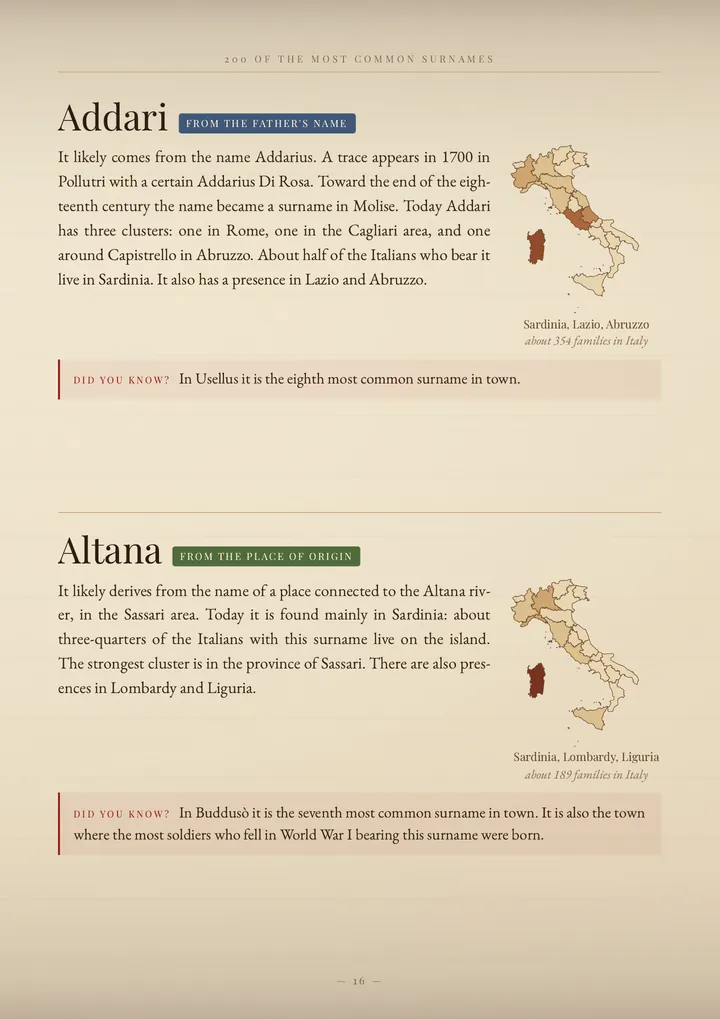
- Origin and meaning
- Map of the regions
- Variants
- Fun facts
- Surnames province by province
- Ancestor guide
300surnames
177pages
11history chapters
The volume at a glance
- Surnames
- 300 new: 200 of the most common and 100 lesser-known
- Pages
- 177, in PDF
- Provinces
- Cagliari, Nuoro, Oristano, Sassari, South Sardinia
- Chapters
- eleven: how a surname changes, the people of the nuraghi, Phoenicians and Carthaginians, Romans, Byzantines, the Judicates and the condaghi, Eleonora and the Peace of 1388, Pisans and Genoese, Catalans and Spaniards, the Corsicans in Gallura, Piedmontese and Tabarchini
What's inside
- For each surname, its origin, its meaning and the language it comes from, mostly Sardinian and then Latin, Spanish, Greek and Germanic
- The map of the Italian regions where it’s common today and an estimate of how many families carry it
- The Sardinian record, when there is one, meaning the surname’s rank on the island or the town where it’s No. 1 or near the top
- The variants, meaning the other forms and spellings of the same surname
- One fun fact per surname, from a town to a historical figure or an old document. In many entries also the soldiers killed in the Great War who were born in a town
- Eleven chapters, from how a surname changes to the peoples who shaped Sardinian surnames, from the people of the nuraghi to the Tabarchini
- The province-by-province index, with the surnames that weigh the most in each, the towns where they’re No. 1, and two indexes, by origin and alphabetical
- A guide to start searching for your ancestors, a family tree to fill in and a surname scroll

Guaranteed PDF: if it won't open or has a fault, we'll fix itPay by card on Payhip, secured by Stripe
- Instant PDF, and the link also arrives by email
- In Italian and English: you get both versions
- A4 format: read it on your phone or print it
Surnames of Sardinia · Volume 2
300 more surnames, all new
This volume comes from your messages. None of its 300 surnames appears in the first book. Many of them you asked for yourselves.
For each one you’ll find where it comes from, what it meant, where it’s found today, the Sardinian town where it is strongest, and a fun fact. When an origin is certain, we write it as certain. When scholars see it differently, we give you every path.
How a surname changes, and who changed it
For centuries the people who carried a surname didn’t write it down. The parish priest did, in the baptism register, sometimes in Italian and sometimes in Spanish or Catalan. From 1866 the town clerk took over, and all it took was a different ear for one family to end up with two surnames. So Artizzu is also Artitzu, Pitzianti becomes Pizzianti, and Ruju sits alongside Ruiu and Rujo. Tanda and Zanda come from the same word, the poppy.
Then there are the peoples. In the monastery condaghi, between the 11th and 13th centuries, two priests named Calaresu already appear. The peace of 1388 between Eleonora’s Arborea and Aragon lists thousands of names, village by village; among the signers are a Matheo Siddu of Sanluri and a Nicolao Loriga of Terranova, today’s Olbia. Pintore, the painter, and Lobina, a fish similar to perch, should come from Catalan. In Gallura the Corsican shepherds left Forteleoni, 11th in Luras. In Carloforte, where Tabarchino is still spoken, No. 1 is Rivano and Parodo is fourth.
The volume has eleven chapters: one on how surnames change and ten on the island’s peoples and stories, from the people of the nuraghi to the Tabarchini. For many of them it lists the surnames in the book that carry their mark.
Province by province
At the back of the volume an index gathers, province by province, the surnames that weigh the most there: 297 surnames from the book, spread across the five provinces from Cagliari to South Sardinia. Then comes the list of the 41 Sardinian towns where a surname from the book is the most common: in Bitti it’s Calvisi, in Posada Deledda, in Cuglieri Idda.
Is your surname in the volume?
Type it below: we'll tell you right away if it's there, and in which volume.
- Addari
- Altana
- Altea
- Angioni
- Aramu
- Arceri
- Ardu
- Aresti
- Arras
- Arru
- Aru
- Arzu
- Bachis
- Ballone
- Bandinu
- Becciu
- Bellu
- Biddau
- Biggio
- Biosa
- Brai
- Budroni
- Bussu
- Cadau
- Calaresu
- Calvia
- Calvisi
- Camedda
- Cancedda
- Cao
- Carai
- Carcangiu
- Carrus
- Caschili
- Castangia
- Catta
- Cauli
- Chironi
- Cireddu
- Cirina
- Cogotti
- Cois
- Colombino
- Concu
- Congia
- Coni
- Corongiu
- Cotza
- Crobu
- Cuboni
- Cucca
- Cuccureddu
- Cuccuru
- Cugusi
- Daga
- Deias
- Deledda
- Del Rio
- Delussu
- Demartis
- Depau
- Deplano
- Derosas
- Desole
- Ecca
- Ena
- Ennas
- Erbi
- Erriu
- Esu
- Etzi
- Falqui
- Fanari
- Figoni
- Firinu
- Foddai
- Fresu
- Furcas
- Gallus
- Gambella
- Gaviano
- Gessa
- Ghironi
- Ghisu
- Giua
- Grussu
- Guiso
- Idda
- Idili
- Idini
- Isoni
- Laconi
- Lallai
- Langiu
- Lecis
- Lepori
- Licheri
- Ligios
- Lisci
- Lobina
- Loche
- Longu
- Loriga
- Loru
- Lutzu
- Madau
- Manchia
- Mancosu
- Manis
- Mannoni
- Manunta
- Manunza
- Marceddu
- Marcia
- Marrocu
- Marrosu
- Martis
- Massidda
- Mastinu
- Masu
- Mattu
- Mela
- Mellino
- Merella
- Migheli
- Montisci
- Mossa
- Murino
- Murroni
- Musu
- Nonnis
- Nurra
- Nuvoli
- Obinu
- Onnis
- Orecchioni
- Ortu
- Paba
- Paderi
- Pais
- Patta
- Patteri
- Piano
- Pibiri
- Picci
- Pilo
- Piludu
- Pintore
- Pippia
- Pirina
- Pirisi
- Piseddu
- Pistidda
- Poddighe
- Porqueddu
- Portas
- Puliga
- Putzulu
- Puxeddu
- Rassu
- Riu
- Rivano
- Rubiu
- Saiu
- Sale
- Sarais
- Sardu
- Sau
- Schintu
- Selis
- Senes
- Serpi
- Serrau
- Setzu
- Seu
- Sias
- Sitzia
- Soggia
- Spissu
- Stara
- Succu
- Tamponi
- Tanda
- Taras
- Tatti
- Tiddia
- Tidu
- Todde
- Trogu
- Trudu
- Tuveri
- Uccheddu
- Uda
- Unali
- Utzeri
- Valdes
- Vidili
- Vincis
- Zaccheddu
- Zanda
- Acca
- Acciaro
- Annis
- Argiolu
- Armas
- Aroffu
- Aroni
- Artizzu
- Asole
- Atzu
- Baldinu
- Balia
- Bardino
- Barrocu
- Battino
- Bomboi
- Bosu
- Brozzu
- Campesi
- Canalis
- Capula
- Carrucciu
- Casta
- Cerina
- Chelo
- Ciccu
- Coccodi
- Coghe
- Cominu
- Cruccu
- Cucciari
- Cugudda
- Curridori
- Cuscusa
- Dedoni
- Defraia
- Deroma
- Era
- Erre
- Espa
- Faa
- Filia
- Fogu
- Forteleoni
- Fulghesu
- Garippa
- Gaspa
- Giordo
- Latte
- Liscia
- Lochi
- Loni
- Lonis
- Lotta
- Lugas
- Maludrottu
- Manueddu
- Marche
- Marzeddu
- Masili
- Medas
- Miscali
- Mocco
- Mudadu
- Mulliri
- Naitana
- Nurchis
- Ollargiu
- Onidi
- Parodo
- Petretto
- Piliu
- Pillai
- Pirroni
- Pisci
- Pittorra
- Pitzianti
- Porcella
- Pruneddu
- Pudda
- Rais
- Rau
- Rosu
- Ruda
- Ruju
- Sanciu
- Sardara
- Serrenti
- Sestu
- Siddu
- Silanos
- Suella
- Talloru
- Tendas
- Urrai
- Vargiolu
- Ximenes
- Zichi
- Zidda
- Zoncheddu
Frequently asked questions
Is my surname in the volume?
The full list of the 300 surnames is on this page. The full story of your surname, written for you, is in the €9.50 booklet on the “Your surname story” page.
How is it different from the first volume of Sardinian surnames?
The surnames are all different: the 300 in this volume don’t appear in the first one. The structure is the same, 200 of the most common surnames and 100 lesser-known ones, with the same entry for each. What changes are the chapters, eleven here because there’s one more on how a surname changes, and the indexes at the back, redone for the surnames in this book.
Will I find the surnames of my province?
At the back of the volume an index gathers, province by province, the surnames that weigh the most there: 297 surnames from the book, spread across the five provinces from Cagliari to South Sardinia. There’s also the list of the 41 Sardinian towns where a surname from the book is the most common.
What’s the difference between the volume and a surname booklet?
In the volume each surname has a half-page entry: origin, map, variants and a fun fact. The booklet is devoted to a single surname and tells its story, its towns and its distribution in 12-19 pages, with a family tree and a surname scroll personalized with that surname.
Does the volume tell me who my ancestors were?
No. A surname tells you where a word comes from, and two families with the same surname can have completely different stories. At the back of the volume there’s a guide to start searching for your ancestors in the archives, free and from home, with tips for Sardinia, where civil registration began in 1866.
Does the volume include my surname’s coat of arms?
No, because a surname has no coat of arms: a coat of arms belonged to one specific branch of a family, not to everyone who carries the surname. When a fun fact mentions one, the entry says which family it belonged to.
What if scholars disagree about the origin?
We tell you. When an origin is certain, it’s written as certain; when it isn’t, the entry carries the gray “disputed origin” badge and gives you the theories.
Can I print it?
Yes, for personal and family use: you can print it for yourself and your relatives.
Surnames of Sardinia · Volume 2
Instant PDF · 177 pages
What people say about us
A few of the more than 20,000 comments and messages you’ve left us.
Read all the reviews