
Lazio’s surnames, people by people
Before Rome, the Latins lived on the Alban Hills and in the plain, and gave their name to the region and to the language. Around Rieti were the Sabines, to the south the Volsci. From them come Latini, Sabelli and Savina. North of the Tiber, in the Tuscia, the Etruscans already had a family name passed from father to son. The surname Tarquini recalls the last kings of Rome, who according to tradition came from there.
A Roman citizen had three names, and the last one started out as a nickname: Scipio meant “staff.” With the fall of the Empire the system was lost, but the names of the great families survived thanks to the saints. In Lazio they became surnames again: Aureli, Fabi, Flamini, Scipioni. In the 6th century the Lombards took the Sabina and the area around Rieti, and their names became Pandolfi, Arduini and Sinibaldi.
For more than a thousand years nearly all of Lazio was ruled by the Popes. From that world come the names of saints and angels, and the notaries’ Latin -is: De Angelis, De Sanctis. Babies left in the wheel of the Santo Spirito hospital, near St. Peter’s, were often given the surname Proietti, from the Latin proiectus, “exposed.” In Ciociaria, the land of the ciocie, small towns and large families produced surnames that barely exist anywhere else. And to the Pontine plain, drained in the 1930s, came thousands of families from Veneto, Friuli and Emilia.
The volume gives a chapter to each of these nine peoples and stories, including the Jews of Rome. For nearly all of them it lists the surnames in the book that carry their mark.
How to recognize a surname from Lazio
Some signs are easy to spot. The final -i is the family plural: Proietti, Mancini. The diminutive in -ucci is the signature of Central Italy: Paolucci, Santucci, Iannucci. And De with the Latin -is comes from the registers of the Papal States: De Angelis, De Santis, De Paolis.
The most common source was the father’s name, often softened: Cola for Nicola, Cecco for Francesco, Meo for Bartolomeo. From there come Colantoni, Ceccarelli and De Meo. And no other place in Italy has so many surnames recalling the great families of ancient Rome. Those names came back into fashion in the Middle Ages and the Renaissance, thanks to the saints and a passion for antiquity.
Province by province
At the back of the volume an index gathers the surnames that weigh most in each province. There are 211 surnames from the book, spread across the five provinces from Frosinone to Viterbo. Then comes the list of the 76 towns in Lazio where a surname from the book is the most common. In Arnara, in Ciociaria, No. 1 is Roma.
Is your surname in the volume?
Type it below: we'll tell you right away if it's there, and in which volume.
- Alessandrini
- Alonzi
- Altobelli
- Amici
- Angelini
- Angelucci
- Antonelli
- Antonini
- Arcangeli
- Arduini
- Aureli
- Basili
- Battisti
- Belli
- Berardi
- Bernabei
- Bocci
- Bonanni
- Bonifazi
- Bottoni
- Bucci
- Camilli
- Campagna
- Campoli
- Capponi
- Cardarelli
- Cardillo
- Carlini
- Carnevale
- Carosi
- Ceccarelli
- Cecchetti
- Ceci
- Celani
- Cerroni
- Cesarini
- Cherubini
- Ciani
- Cinelli
- Ciotti
- Coccia
- Colantoni
- Colasanti
- Coletta
- Corsetti
- Costantini
- Crescenzi
- Cruciani
- D’Andrea
- D’Angeli
- D’Annibale
- De Angelis
- De Bonis
- De Carolis
- Del Monte
- De Meo
- De Paolis
- De Sanctis
- De Santis
- Desideri
- Di Fazio
- Di Girolamo
- Di Mario
- Dionisi
- Di Russo
- Di Vito
- Dominici
- Ercolani
- Ercoli
- Evangelista
- Evangelisti
- Fabi
- Fabiani
- Fabrizi
- Faiola
- Falasca
- Fantozzi
- Federici
- Felici
- Fioravanti
- Fiorentini
- Fiorini
- Fornari
- Forti
- Fortuna
- Fraioli
- Frasca
- Fratini
- Frezza
- Gabriele
- Gabrielli
- Gentili
- Germani
- Giuliani
- Gizzi
- Graziani
- Graziosi
- Gregori
- Iacovacci
- Iannucci
- Innocenzi
- Ippoliti
- Latini
- Lattanzi
- Lauretti
- Lauri
- Liberati
- Lisi
- Loreti
- Lucarelli
- Lucci
- Luciani
- Lucidi
- Lupi
- Mancini
- Manni
- Marcelli
- Marchetti
- Mari
- Marrocco
- Marsella
- Masci
- Massimi
- Mattei
- Mattia
- Maurizi
- Mei
- Menichelli
- Mercuri
- Moriconi
- Moscatelli
- Nobili
- Olivieri
- Ottaviani
- Pagliaroli
- Palombi
- Palombo
- Pandolfi
- Paniccia
- Paolucci
- Paris
- Pascucci
- Pasquali
- Perciballi
- Petroni
- Petrucci
- Pica
- Piccioni
- Pizzuti
- Placidi
- Polidori
- Pompei
- Pompili
- Ponzo
- Priori
- Proietti
- Pulcini
- Ranucci
- Raponi
- Reali
- Renzi
- Ricci
- Risi
- Rocchi
- Roma
- Romani
- Ronci
- Rosati
- Rotondi
- Sabatini
- Salustri
- Salvati
- Santilli
- Santori
- Santucci
- Savo
- Scipioni
- Sebastianelli
- Sebastiani
- Serafini
- Sestili
- Silvestri
- Simonelli
- Simonetti
- Spaziani
- Stazi
- Tarquini
- Tempesta
- Teodori
- Terenzi
- Tomassi
- Tomei
- Tranquilli
- Trombetta
- Urbani
- Valente
- Valentini
- Valeri
- Venditti
- Vittori
- Ambrosetti
- Antonetti
- Ascenzi
- Belardi
- Brizi
- Calcagni
- Caponera
- Capparella
- Caratelli
- Cardoni
- Carocci
- Ceccacci
- Cedrone
- Celletti
- Censi
- Cerqua
- Cervoni
- Ciccotti
- Cirulli
- Consalvi
- Cori
- Cristofari
- Diamanti
- Egidi
- Emili
- Eramo
- Eusepi
- Fagiolo
- Fazi
- Feliziani
- Felli
- Ferracci
- Ferrazza
- Flamini
- Francucci
- Funari
- Gasbarra
- Gasbarri
- Giansanti
- Girolami
- Giubilei
- Giustini
- Iacobelli
- Ilari
- Imperatori
- Lancia
- Lanni
- Lenci
- Ludovici
- Ludovisi
- Lupino
- Macera
- Mammucari
- Manili
- Massimiani
- Mastrangeli
- Mastrantoni
- Mastrantonio
- Meschini
- Micozzi
- Morgia
- Mostarda
- Necci
- Neroni
- Oddi
- Ortenzi
- Paciotti
- Pannozzo
- Panzironi
- Petrilli
- Piergentili
- Pietrangeli
- Pietrobono
- Pinci
- Pistilli
- Pomponi
- Porretta
- Quadrana
- Ranaldi
- Rapone
- Riccioni
- Rufini
- Sabelli
- Sabellico
- Saccucci
- Savina
- Sbardella
- Scacco
- Scarsella
- Segatori
- Sinibaldi
- Sorge
- Sperduti
- Tata
- Ubertini
- Valeriani
- Vari
- Venanzi
- Vona
- Zangrilli
Surnames in red also have their own booklet.
FAQ
Is my surname in the volume?
The full list of the 300 surnames is on this page. If yours isn’t there, request it through our contact page: new booklets come from the most requested surnames.
How is it different from the volume on Central Italy?
The Central Italy volume picks 300 surnames from four regions. This one is devoted to Lazio alone: nine chapters on the region’s peoples and stories and, when there is one, each surname’s record in Lazio. 105 surnames are in both: the other 195 you’ll find only here.
Will I find the surnames of my province?
At the back of the volume an index gathers the surnames that weigh most in each province. There are 211 surnames from the book, spread across the five provinces, not just Rome. There’s also the list of the 76 towns in Lazio where a surname from the book is the most common.
What’s the difference between the volume and a surname booklet?
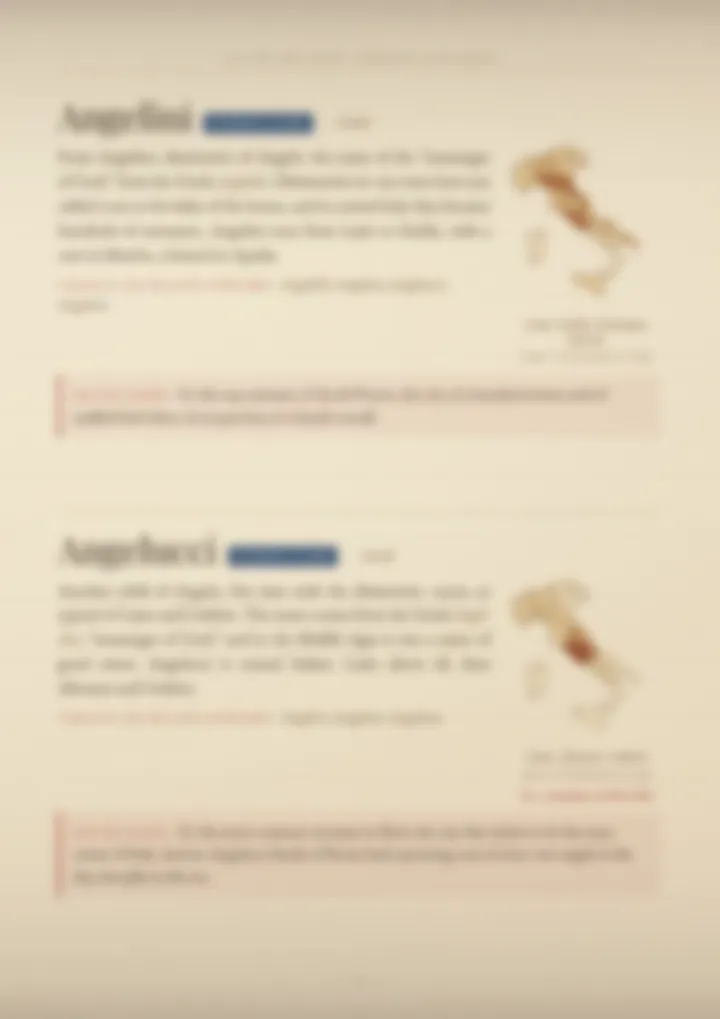
In the volume each surname has a half-page entry: origin, map, variants and a fun fact. The booklet is devoted to a single surname and tells its story, its towns and its distribution in 12-19 pages. It also has a family tree and a scroll made out to that surname.
Does the volume tell me who my ancestors were?
No. A surname tells you where a word comes from, and two families with the same surname can have completely different stories. At the back of the volume there’s a guide to searching for your ancestors in the archives, free and from home. It includes tips for Lazio. In the Papal lands civil registration became permanent from 1871; in the south, which belonged to the Kingdom of Naples, it was already in place from 1809.
Does the volume include my surname’s coat of arms?
No, because a surname has no coat of arms. A coat of arms belonged to one specific branch of a family, not to everyone who carries the surname. When a fun fact mentions one, the entry says which family it belonged to.
What if scholars disagree about the origin?
We tell you. When an origin is certain, it’s written as certain. When it isn’t, the entry carries the gray “disputed origin” badge and gives you the theories.
Can I print it?
Yes, for personal and family use: you can print it for yourself and your relatives.


