

The surnames of Friuli-Venezia Giulia, people by people
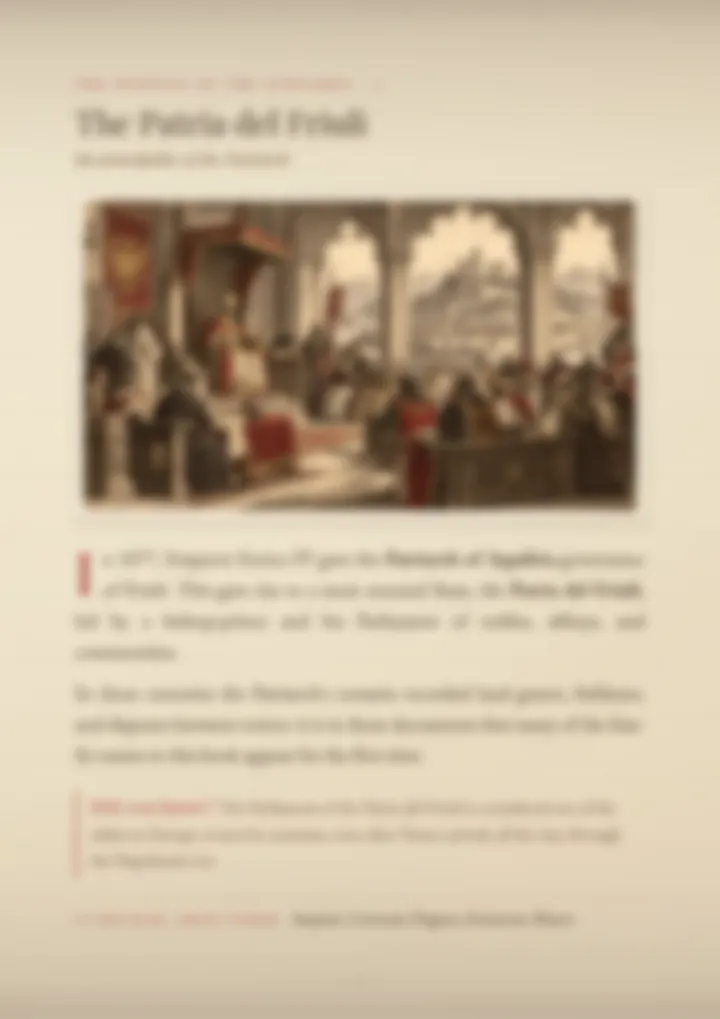
In 181 BC the Romans founded Aquileia, a border colony that became one of the largest cities of the Empire. With the Romans came Latin, the source of Friulian. In 568 the Lombards entered Italy by way of Friuli itself, and at Cividale, the ancient Forum Iulii, King Alboin left the first of their duchies: the city’s name gave Friuli its own name. In 1077 Emperor Henry IV gave the Patriarch of Aquileia the rule of Friuli, and the Patria del Friuli was born, led by a bishop-prince and his Parliament. In 1420 Venice conquered Friuli and held it for almost four centuries: many names took a Venetian form, Zuan for Giovanni, Bortolo for Bartolomeo.
From the 7th–8th century groups of Slavs settled in the eastern valleys of Friuli, and Slovene, in its local varieties, is still spoken there today. In the Middle Ages German-speaking families climbed to Sauris, Timau and Sappada, and in the Val Canale German was spoken because the valley was Austrian until 1919. In 1719 Emperor Charles VI made Trieste a free port: Friulians, Venetians, Slovenes, Croats, Greeks, Serbs, Jews, Germans and Levantines arrived by the thousands, and in Trieste Furlan, meaning “the Friulian,” is the most common surname in the city.
Many surnames come from the father’s name, almost always shortened and made affectionate: Cola for Nicola, Cecco for Francesco, Tonin for Antonio. From Nicola come Colautti, Colussi and Collovati, from Bartolomeo Bortolussi, Bortolin and Bertolo. For centuries the men of Carnia spent the winter on the road: they were the cramârs, peddlers who crossed the Alps with the crassigne on their backs, a wooden cabinet full of drawers. From the 1800s into the 1900s, meanwhile, Friuli was a land of emigration, and wherever they arrived Friulians founded a Fogolâr furlan, the “Friulian hearth.”
The volume gives a chapter to each of these ten peoples and stories. For almost all of them it lists the surnames in the book that carry its mark.
How to recognize a Friulian surname
Some signs are easy to spot. The diminutives in -ut and -uss, which became -utti and -ussi: Colautti, Cecotti, Biasutti, Colussi, Bortolussi, Mattiussi. If a surname ends like that, the family almost always has roots here. The Venetian -in for “little”: Bortolin, Nadalin, Tomasin, Zorzin. And the Latin -is of the notaries: de Fabris, “of the family of smiths.” In medieval documents surnames were written in Latin, and in Friuli that notary’s form stayed attached to the family name, while elsewhere it disappeared.
Province by province
At the back of the volume an index gathers, province by province, the surnames most common there: 283 surnames from the book, spread across the four provinces from Gorizia to Udine. Then comes the list of the 64 towns in Friuli-Venezia Giulia where a surname from the book is the most common: in Trieste, for example, No. 1 is Furlan, and in Pordenone it is Santarossa.
Is your surname in the volume?
Type it below: we'll tell you right away if it's there, and in which volume.
- Antonutti
- Apollonio
- Asquini
- Baldassi
- Battistutta
- Bellina
- Beltrame
- Beltramini
- Bergamasco
- Bernardis
- Bertoia
- Bertolo
- Bertossi
- Biasutti
- Bomben
- Bon
- Bortolin
- Bortolussi
- Boscarol
- Bottos
- Braida
- Braidotti
- Brandolin
- Bravin
- Brunetta
- Brusadin
- Bulfon
- Bulfone
- Cadelli
- Calligaris
- Calligaro
- Canciani
- Candotti
- Candotto
- Candusso
- Cantarutti
- Cargnelutti
- Casasola
- Castellarin
- Cattaruzza
- Cechet
- Cecotti
- Ceschia
- Cescutti
- Chiaradia
- Colautti
- Collovati
- Colussi
- Comelli
- Cominotto
- Comisso
- Comuzzi
- Concina
- Contardo
- Corazza
- Corbatto
- Cosolo
- Cristante
- Cudicio
- Danelon
- De Biasio
- De Cecco
- Degano
- Degrassi
- Del Ben
- Del Bianco
- Del Fabbro
- Del Frate
- Della Mea
- Del Negro
- Del Zotto
- De Monte
- De Piero
- Di Giusto
- Di Lenardo
- D’Odorico
- Domini
- Dorigo
- Duri
- Ellero
- Ermacora
- Fabbro
- Fabris
- Fabro
- Fachin
- Faggiani
- Favot
- Fedrigo
- Ferluga
- Feruglio
- Fior
- Floreani
- Fogar
- Fonda
- Fontanot
- Forgiarini
- Franceschinis
- Franz
- Furlan
- Furlani
- Gerin
- Giorgiutti
- Giust
- Gregoris
- Gustin
- Iacuzzi
- Infanti
- Iob
- Iuri
- Lenardon
- Lenarduzzi
- Lizzi
- Lovisa
- Macor
- Macorig
- Magris
- Mansutti
- Marchesan
- Marcuzzi
- Martin
- Martinis
- Martinuzzi
- Mattiussi
- Medeot
- Mian
- Miani
- Michelin
- Michelutti
- Miconi
- Molaro
- Morandini
- Moras
- Muzzin
- Nadalin
- Noacco
- Pagnutti
- Paron
- Paviotti
- Peric
- Petris
- Petronio
- Pevere
- Piani
- Piccinin
- Pighin
- Pignat
- Pin
- Pitton
- Pivetta
- Pividori
- Polese
- Pontoni
- Pozzar
- Revelant
- Rigonat
- Rodaro
- Roman
- Romanello
- Romanin
- Ros
- Rosset
- Sacilotto
- Salvador
- Sandrin
- Sant
- Santarossa
- Santin
- Scian
- Sist
- Spagnol
- Specogna
- Spessot
- Stefanutti
- Toffolo
- Tomasella
- Tomasin
- Toneatto
- Tonizzo
- Tosolini
- Turchet
- Urban
- Valent
- Vascotto
- Vecchiet
- Venier
- Venuti
- Verardo
- Vidoni
- Visintin
- Visintini
- Vuerich
- Zanello
- Zanette
- Zannier
- Zanolla
- Zanutta
- Zanutto
- Zorzenon
- Zorzin
- Zuliani
- Andreutti
- Anzil
- Babich
- Bearzi
- Benes
- Beorchia
- Bisaro
- Blason
- Bolzicco
- Brovedani
- Busolini
- Casarsa
- Casco
- Celant
- Cesaratto
- Chiaruttini
- Cicuttini
- Cocetta
- Comuzzo
- Copat
- Cossutta
- Craighero
- Cucchiaro
- Cum
- Cuttini
- Danielis
- Dean
- Deana
- Favret
- Ferigo
- Fragiacomo
- Franzolini
- Frausin
- Gaiardo
- Gallas
- Galliussi
- Garbino
- Gaspardo
- Gergolet
- Gerometta
- Glavina
- Gnesutta
- Gortan
- Gri
- Leonarduzzi
- Leschiutta
- Lupieri
- Mainardis
- Maniago
- Marangone
- Marinig
- Marizza
- Meazzo
- Medves
- Melchior
- Menis
- Missio
- Modonutti
- Morassi
- Morassutti
- Morsut
- Pascoletti
- Pascolo
- Pelos
- Perossa
- Pezzutti
- Pitacco
- Pitassi
- Pittini
- Pozzetto
- Presot
- Puntel
- Quattrin
- Radin
- Redivo
- Rigutto
- Rossit
- Rover
- Rugo
- Scodellaro
- Sedran
- Sinicco
- Soranzio
- Spizzo
- Taiariol
- Tassan
- Todone
- Tonutti
- Tortul
- Ulian
- Vaccher
- Venchiarutti
- Venerus
- Viezzoli
- Vittor
- Vogrig
- Volpatti
- Zamaro
- Zamparutti
- Zucchet
Surnames in red also have their own booklet.
FAQ
Is my surname in the volume?
The full list of the 300 surnames is on this page. If yours isn’t there, request it through our contact page: new booklets come from the most requested surnames.
How is it different from the volume on Northern Italy?
The Northern Italy volume picks 300 surnames from eight regions. This one is devoted to Friuli-Venezia Giulia alone: ten chapters on the region’s peoples and stories and, when there is one, where each surname ranks in Friuli or Venezia Giulia. 23 surnames are in both: the other 277 you’ll find only here.
Will I find the surnames of my province?
At the back of the volume an index gathers, province by province, the surnames most common there: 283 surnames from the book, spread across the four provinces from Gorizia to Udine. There’s also the list of the 64 towns in Friuli-Venezia Giulia where a surname from the book is the most common.
What’s the difference between the volume and a surname booklet?
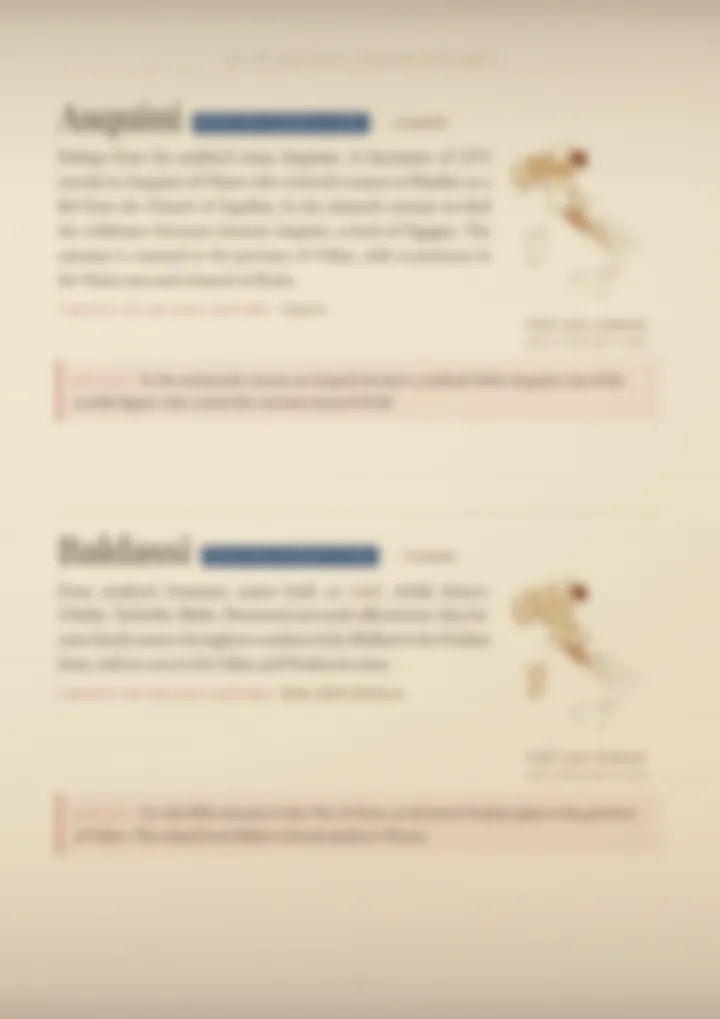
In the volume each surname has a half-page entry: origin, map, variants and a fun fact. The booklet is devoted to a single surname and tells its story, its towns and its distribution in 12-19 pages, with a family tree and a surname scroll personalized with that surname.
Does the volume tell me who my ancestors were?
No. A surname tells you where a word comes from, and two families with the same surname can have completely different stories. At the back of the volume there’s a guide to start searching for your ancestors in the archives, free and from home, with tips for Friuli-Venezia Giulia, where in Friuli civil registration already existed under Napoleon, from 1806 to 1815, while in Trieste and Gorizia Italian civil registration began in 1924.
Does the volume include my surname’s coat of arms?
No, because a surname has no coat of arms: a coat of arms belonged to one specific branch of a family, not to everyone who carries the surname. When a fun fact mentions one, the entry says which family it belonged to.
What if scholars disagree about the origin?
We tell you. When an origin is certain, it’s written as certain; when it isn’t, the entry carries the gray “disputed origin” badge and gives you the theories.
Can I print it?
Yes, for personal and family use: you can print it for yourself and your relatives.
