Surnames of Bari
origin, meaning, distribution and fun facts


€14.90 Instant PDF · 72 pages
Buy the volumeGuaranteed PDF: if it won't open or has a fault, we'll fix itPay by card on Payhip, secured by Stripe
- Instant PDF, and the link also arrives by email
- In Italian and English: you get both versions
- A4 format: read it on your phone or print it
Bari was already a center of the Peucetians when the Romans called it Barium. Then Byzantium made it the capital of the Catepanate of Italy, in 847 the Saracens founded an emirate here and in 1071 the Normans arrived. Everyone who passed through left something in the surnames: a Greek word, the name of a warrior from the North or the name of a town in the Murgia.
In this volume you’ll find 100 surnames tied to the province of Bari: 70 surnames at home here, the ones that count more families here than anywhere else in Italy, and 30 surnames from the smaller towns, rare, sometimes very rare, tied to one or two municipalities. They were chosen from the ones you wrote to us about in the comments under our videos.
- Origin and meaning
- Map of the regions
- Variants
- Fun facts
- The No. 1 surname of each town
- Ancestor guide
100surnames
72pages
7history chapters
The volume at a glance
- Surnames
- 100: 70 at home in Bari and 30 from the smaller towns
- Pages
- 72, in PDF
- Area
- Bari and its province: Monopoli, Polignano a Mare, Altamura, Alberobello, Locorotondo and the towns of the Murgia
- Chapters
- seven, on the peoples and stories behind Bari’s surnames: Greeks and Byzantines, Arabs, Normans and Swabians, Goths and Lombards, Aragonese and Spanish, the Jews of Bari, surnames that are town names
What's inside
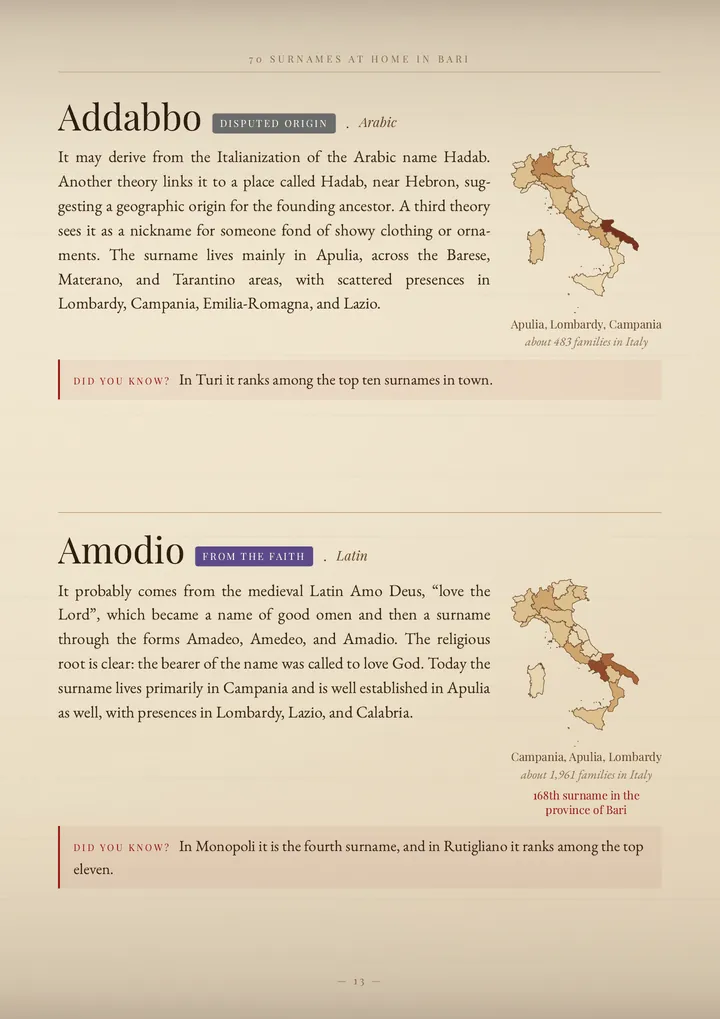
- For each surname, its origin, its meaning and the language it comes from, from Latin to Greek, from Germanic to Arabic
- The map of the Italian regions where it’s common today and an estimate of how many families carry it
- Its standing in the province, when there is one, meaning the town in the province where the surname ranks first or in the top three, or its place in the province’s ranking
- The variants, meaning the other forms and spellings of the same surname
- One fun fact per surname, from a town to a historical figure
- Seven chapters on the peoples and stories behind Bari’s surnames, from the Greeks and Byzantines to the Jews of Bari
- The index of the most common surnames in the province, the No. 1 surname of 41 municipalities, and two indexes, by origin and alphabetical
- A guide to start searching for your ancestors, a family tree to fill in and a surname scroll

Guaranteed PDF: if it won't open or has a fault, we'll fix itPay by card on Payhip, secured by Stripe
- Instant PDF, and the link also arrives by email
- In Italian and English: you get both versions
- A4 format: read it on your phone or print it
Surnames of Bari
The surnames of Bari, one people at a time
Bari was already a center of the Peucetians when the Romans called it Barium. Under Byzantium it became the capital of the Catepanate of Italy, the province that governed southern Italy. In 847 a group of Saracen soldiers took the city and founded an emirate there, the only Islamic state ever to exist on the Italian mainland. In 1071 Robert Guiscard conquered it. In 1442 Alfonso V of Aragon took the Kingdom of Naples, and Apulia stayed under the Spanish crown for almost three centuries. Every people left something in the surnames of the city and the towns around it.
Many surnames from Bari hide a Greek word: Barile, Milella, Teofilo, Varvara. The names of warriors from the North became surnames of the Murgia and the Adriatic coast: Bavaro, Gesmundo and Brandonisio have Germanic roots. Berloco is perhaps of Norman origin and Addabbo perhaps comes from an Arabic name. The volume gives a chapter to each of these peoples and stories and, when there are any, lists the surnames in the book that carry their mark.
The volume is frank about the Jews of Bari. In the Kingdom of Naples the expulsions came in 1510 and, for good, in 1541. Those who stayed had to convert, and they generally took common Christian first names and surnames. That is why there are no surnames from Bari that are certainly Jewish.
How to recognize a surname from Bari
Some signs are easy to spot. The De in front, which the records sometimes drop: De Bellis, De Gennaro, De Chirico, De Pinto. Nicknames born in the town square, like Mangialardi, Sciancalepore or Sgobba. And surnames that are place names, like Castellaneta, Valenzano and Romanazzi: whoever moved away took the name of the place along.
Sciancalepore probably comes from someone who ran as fast as a hare. Sgobba, from someone who carried loads so heavy they bent the back. In the towns of the province every family often has a family nickname too, passed from father to son without being written down anywhere. It is the same mechanism that gave rise to surnames centuries ago.
Seventy at home, thirty from the towns
The volume starts with the 70 surnames at home in Bari, the ones that count more families in the province than anywhere else in Italy. Then come 30 surnames from the smaller towns, rare, sometimes very rare, tied to one or two municipalities. They come from the city itself and the coast with Monopoli and Polignano, from Altamura and the towns of the Murgia, from Alberobello and Locorotondo in the hills.
Lorusso, Fiore and Pinto are at home all over Apulia, and you’ll find them already in the volume I cognomi di Puglia (Surnames of Apulia). Here are the surnames you’re much less likely to meet outside the province.
The indexes at the back
At the back, one index lists the twenty surnames carried by the most families between Bari and its towns. Another gives the No. 1 surname of 41 municipalities in the province, from Acquaviva delle Fonti to Valenzano, and marks the ones told in the volume. An index by origin and an alphabetical one follow.
Is your surname in the volume?
Type it below: we'll tell you right away if it's there, and in which volume.
- Addabbo
- Amodio
- Angelillo
- Angiuli
- Annese
- Antonicelli
- Ardito
- Barile
- Bavaro
- Berloco
- Bitetto
- Caldarola
- Cannito
- Cantatore
- Caputi
- Castellaneta
- Casulli
- Colacicco
- Colasanto
- De Bellis
- De Candia
- De Chirico
- De Gennaro
- De Pinto
- Diaferia
- Didonna
- Fanizzi
- Fiume
- Fracchiolla
- Furio
- Genchi
- Gennaro
- Giorgio
- Giosa
- Giove
- Labarile
- L’Abbate
- Lacalamita
- Lassandro
- Lastella
- Lobascio
- Maldera
- Mallardi
- Mangialardi
- Maselli
- Mazzilli
- Milella
- Milillo
- Minafra
- Minervini
- Montaruli
- Nitti
- Notarnicola
- Nuzzi
- Panaro
- Pansini
- Pascazio
- Puglia
- Recchia
- Romanazzi
- Schiraldi
- Sciancalepore
- Sforza
- Sgobba
- Spadavecchia
- Stragapede
- Strippoli
- Valenzano
- Ventrella
- Vitucci
- Acquafredda
- Borracci
- Brandonisio
- Burdi
- Campobasso
- Capozzo
- Colavito
- D’Aprile
- Gesmundo
- Giustino
- Incampo
- Lagioia
- Loiodice
- Manghisi
- Masciopinto
- Mastrolonardo
- Minenna
- Palmiotto
- Peragine
- Quarato
- Redavid
- Romita
- Schiralli
- Servedio
- Stasolla
- Stellacci
- Tarricone
- Teofilo
- Ursi
- Varvara
Frequently asked questions
What are the most common surnames in Bari?
First place goes to Lorusso, with about 2,118 families in the province. At the back of the volume, one index lists the twenty surnames carried by the most families and another gives the No. 1 surname of 41 municipalities. They are common outside the province too, and almost all of them are told in the volume Surnames of Apulia. Here you’ll find the surnames born in the province of Bari, which you meet much less often elsewhere.
Is my surname from Bari?
If it’s among the 100 on this page, it’s tied to the province of Bari: 70 are at home in the province and 30 belong to one or two towns. If you don’t find it, it may be a surname found all over Apulia: then look for it in the volume Surnames of Apulia. A surname tells you where a word comes from: to learn who your ancestors were, you need the records.
How is it different from the volume on Apulia?
The Apulia volume gathers the surnames of the whole region, including those found in every province, like Lorusso, Fiore and Pinto. This one is devoted to Bari and its towns, with seven chapters on the peoples and stories behind Bari’s surnames.
Will I find the surname of my town?
One index gives the most common surname in 41 municipalities of the province, from Acquaviva delle Fonti to Valenzano. The 30 surnames from the towns are rare, sometimes very rare, and each is tied to one or two municipalities.
Does the volume tell me who my ancestors were?
No. A surname tells you where a word comes from. Two families with the same surname can have completely different stories. At the back of the volume there’s a guide to start searching for your ancestors, free and from home, with tips for southern Italy, where civil registration began in 1809.
Does the volume include my surname’s coat of arms?
No, because a surname has no coat of arms: a coat of arms belonged to one specific branch of a family, not to everyone who carries the surname. When a fun fact mentions one, the entry says which family it belonged to.
What if scholars disagree about the origin?
We tell you. When an origin is certain, it’s written as certain; when it isn’t, the entry carries the gray “disputed origin” badge and gives you the theories.
Can I print it?
Yes, for personal and family use: you can print it for yourself and your relatives.
Surnames of Bari
Instant PDF · 72 pages
What people say about us
A few of the more than 20,000 comments and messages you’ve left us.
Read all the reviews