
Abruzzo’s surnames, people by people
Before Rome, the valleys of Abruzzo belonged to the Italic peoples: the Vestini, Marsi, Peligni, Marrucini, Frentani and Pretuzi. From the Pretuzi, who lived around Teramo, comes the medieval name of the region, Aprutium. In 90 BC they rebelled against Rome to win citizenship and made Corfinio their capital under a new name: Italia. They lost the war but won citizenship, and Latin became their language.
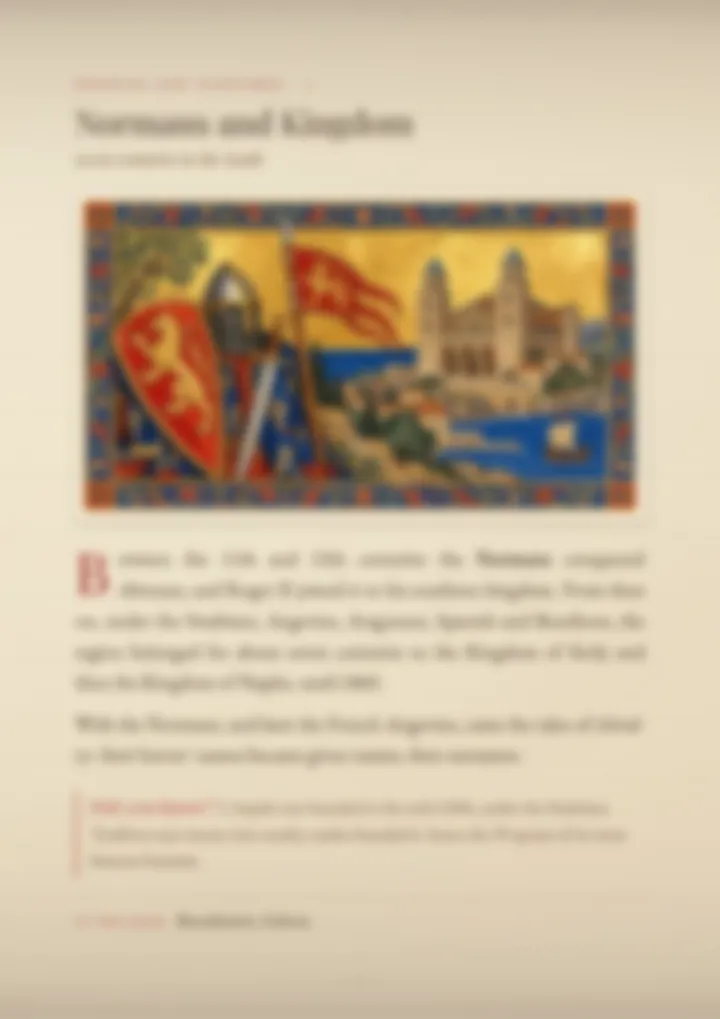
At the end of the 6th century the Lombards arrived, then the Franks of Charlemagne, and their warrior names mixed with Latin names. Berardo was so loved in Abruzzo that it alone gave rise to an entire family of surnames, from Berardinelli to Di Giamberardino. Between the 11th and 12th centuries the Normans conquered the region, which for about seven centuries belonged to the Kingdom of Sicily and then the Kingdom of Naples, until 1860.
For centuries Abruzzo was the land of the transhumance: in autumn the flocks went down toward Apulia along the tratturi, grass roads more than a hundred meters wide, and shepherds and wool merchants left their trades in surnames. Between the 15th and 16th centuries, fleeing the advance of the Turks, families from Dalmatia and the Balkans arrived on the coast, the Schiavoni (Slavs), along with the Albanians, who in 1743 founded Villa Badessa, near Pescara. From the late 1800s to the 1960s, hundreds of thousands of people from Abruzzo left: that is why you will find many of the book’s surnames in Toronto, Philadelphia or Buenos Aires.
The volume gives a chapter to each of these eight peoples and stories. For each one it lists the surnames in the book that carry their mark.
How to recognize an Abruzzo surname
In Abruzzo more than anywhere else, the surname came from the father’s name. That is why the region is full of Di, De and D’: Di Marco, Di Paolo, Di Giovanni, D’Alfonso, D’Orazio. Almost half of the 200 most common surnames in the book begin that way, and it means “son of.” Then come the Latin forms of the notaries: De Berardinis, De Laurentiis, De Flaviis. And the affectionate endings -ucci, -etti, -ini, -elli, which turn a single name into several different families.
Why De Berardinis and not De Berardini? In Latin records they wrote de Berardinis, “of the Berardini,” with the Latin plural ending. In many parts of Italy the form was translated; in Abruzzo and the neighboring regions it stayed just as it was on paper. The same name gave different surnames: from Domenico come Di Domenico and De Dominicis, from Lorenzo Di Lorenzo and De Laurentiis. The first is the parish priest’s everyday speech, the second the notary’s Latin.
Province by province
At the back of the volume an index gathers the surnames most common in each province. There are 255 surnames from the book, spread across the four provinces, Chieti, L’Aquila, Pescara and Teramo. Then comes the list of the 41 Abruzzo towns where a surname from the book is the most common. In Chieti, No. 1 is Iezzi.
Is your surname in the volume?
Type it below: we'll tell you right away if it's there, and in which volume.
- Colantonio
- D’Ettorre
- Di Giacomo
- Capuani
- Colasante
- D’Eugenio
- Di Giamberardino
- De Vincentiis
- Di Giampaolo
- Consorti
- Di Antonio
- Di Giandomenico
- Angelone
- Carulli
- Di Bartolomeo
- Di Giovannantonio
- Antenucci
- Carusi
- Di Battista
- Di Giovanni
- Crisante
- Di Berardino
- Di Giulio
- Di Biase
- Di Giuseppe
- D’Adamo
- Di Blasio
- D’Ignazio
- Assogna
- D’Addario
- Di Bonaventura
- Di Lello
- D’Alberto
- Di Camillo
- Di Leonardo
- Centofanti
- D’Alfonso
- Di Campli
- Di Loreto
- Centorame
- D’Aloisio
- Di Carlo
- Di Luca
- D’Alonzo
- Di Cesare
- Di Luzio
- Bellisario
- D’Amario
- Di Clemente
- Di Marcantonio
- Berardinelli
- D’Annunzio
- Di Cola
- Di Marco
- Berardinucci
- D’Arcangelo
- Di Crescenzo
- Di Marzio
- Bisegna
- D’Ascanio
- Di Domizio
- Di Mattia
- Bomba
- Cianci
- De Amicis
- Di Egidio
- Di Michele
- De Berardinis
- Di Fabio
- Di Muzio
- Cicchini
- De Dominicis
- Di Febo
- Di Nella
- Buccella
- Cicchitti
- De Flaviis
- Di Federico
- Di Nicola
- De Laurentiis
- Di Felice
- D’Innocenzo
- Del Borrello
- Di Florio
- Di Nunzio
- Camaioni
- Dell’Elce
- Di Fonzo
- Candelori
- Cimini
- Del Monaco
- Di Francesco
- Diodato
- Candeloro
- Cipollone
- D’Emilio
- Di Pancrazio
- Cantagallo
- Cirone
- Di Gaetano
- Di Paolo
- Clementoni
- D’Eramo
- Di Genova
- Di Pietrantonio
- Caporale
- D’Ercole
- Di Giacinto
- Di Pietro
- Di Prinzio
- Forcella
- Malandra
- Paolone
- Di Renzo
- Fracassi
- Di Rocco
- Fuschi
- Di Sabatino
- Marchesani
- Pelusi
- Spadaccini
- Di Salvatore
- Persia
- Di Sante
- Piccirilli
- Di Saverio
- Galiffa
- Marcone
- Di Silvestre
- Marinucci
- Pierfelice
- Staniscia
- Di Teodoro
- Di Tullio
- Giammarco
- Marziani
- Polidoro
- Di Vincenzo
- Giammarino
- Di Virgilio
- Giampietro
- Pomponio
- Tenaglia
- Donatelli
- Giancola
- Masciarelli
- Tiberio
- D’Orazio
- Giancristofaro
- Presutti
- Toro
- D’Ottavio
- Giansante
- Masciulli
- Primavera
- D’Ovidio
- Ranalli
- Torrieri
- D’Urbano
- Guardiani
- Rapino
- Trabucco
- Faieta
- Iachini
- Travaglini
- Falone
- Fantauzzi
- Iacobucci
- Melchiorre
- Renzetti
- Ursini
- Fasciani
- Iannetti
- Vallese
- Iezzi
- Rocci
- Ventresca
- Febo
- Rulli
- Verna
- Feliciani
- Lanci
- Montebello
- Felicioni
- Salvatore
- Fidanza
- Leonzi
- Morgante
- Salvatorelli
- Zappacosta
- Finocchio
- Leonzio
- Narcisi
- Liberatore
- Saraceni
- Zinni
- Scarpone
- Zuccarini
- Florindi
- Zulli
- Agresta
- Caprioni
- Amicone
- Amicucci
- Carafa
- Consorte
- Ammazzalorso
- Caramanico
- Cordone
- Corneli
- Aquilano
- Casalena
- Artese
- Cavuto
- Crognale
- Ascenzo
- Cellini
- Cellucci
- Barnabei
- Centi
- Basciani
- Bellano
- Bellante
- Cerasa
- Cerasoli
- Ciampini
- Ciampoli
- Ciancarella
- Bonaduce
- Cicchinelli
- Brandimarte
- Buffone
- Ciccotosto
- Calista
- Cichetti
- Cicioni
- Diodati
- Di Fulvio
- De Nardis
- Capanna
- Colanero
- Silveri
- Marcanio
- Pasquarelli
- Sorgi
- Marcantonio
- Pellicciotta
- Spacca
- Fusella
- Fusilli
- Marchione
- Spezialetti
- Galeota
- Marchionne
- Spinosi
- Piccone
- Stanisci
- Gambacorta
- Gasbarro
- Marulli
- Pietrangelo
- Stante
- Stati
- Marzoli
- Pompa
- Stivaletta
- Masciantonio
- Porreca
- Mascioli
- Torricella
- Giardinelli
- Massimini
- Mastrocola
- Matricardi
- Raspa
- Iacoboni
- Medori
- Remigio
- Troilo
- Memmo
- Ricciuti
- Fattore
- Mirabilio
- Italiani
- Montaldi
- Sacchini
- Verrocchi
- Lemme
- Moretta
- Vitullo
- Santone
- Zavarella
- Firmani
- Paglione
- Flacco
- Libertini
- Palmitesta
- Luccitti
- Pantalone
- Sigismondi
FAQ
Is my surname in the volume?
The full list of the 300 surnames is on this page. If yours isn’t there, request it through our contact page: new booklets come from the most requested surnames.
How is it different from the volume on the South and the Islands?
The South volume picks 300 surnames from eight regions. This one is devoted to Abruzzo alone: eight chapters on the region’s peoples and stories and, when there is one, the place in Abruzzo where each surname ranks highest. 9 surnames are in both: the other 291 you’ll find only here.
Will I find the surnames of my province?
At the back of the volume an index gathers the surnames most common in each province. There are 255 surnames from the book, spread across Chieti, L’Aquila, Pescara and Teramo. There’s also the list of the 41 Abruzzo towns where a surname from the book is the most common.
What’s the difference between the volume and a surname booklet?
In the volume each surname has a half-page entry: origin, map, variants and a fun fact. The booklet is devoted to a single surname and tells its story, its towns and its distribution in 12-19 pages. It also has a family tree and a surname scroll personalized with that surname.
Does the volume tell me who my ancestors were?
No. A surname tells you where a word comes from, and two families with the same surname can have completely different stories. At the back of the volume there’s a guide to searching for your ancestors in the archives, free and from home. It includes tips for Abruzzo, where civil registration begins in 1809, when the region was part of the Kingdom of Naples: before that the parish priests kept the records.
Does the volume include my surname’s coat of arms?
No, because a surname has no coat of arms. A coat of arms belonged to one specific branch of a family, not to everyone who carries the surname. When a fun fact mentions one, the entry says which family it belonged to.
What if scholars disagree about the origin?
We tell you. When an origin is certain, it’s written as certain. When it isn’t, the entry carries the gray “disputed origin” badge and gives you the theories. For some extremely rare surnames that nobody has studied yet, the entry says exactly that.
Can I print it?
Yes, for personal and family use: you can print it for yourself and your relatives.