
October 1, 2026 · 5 min read
There Is No Crest for Your Surname
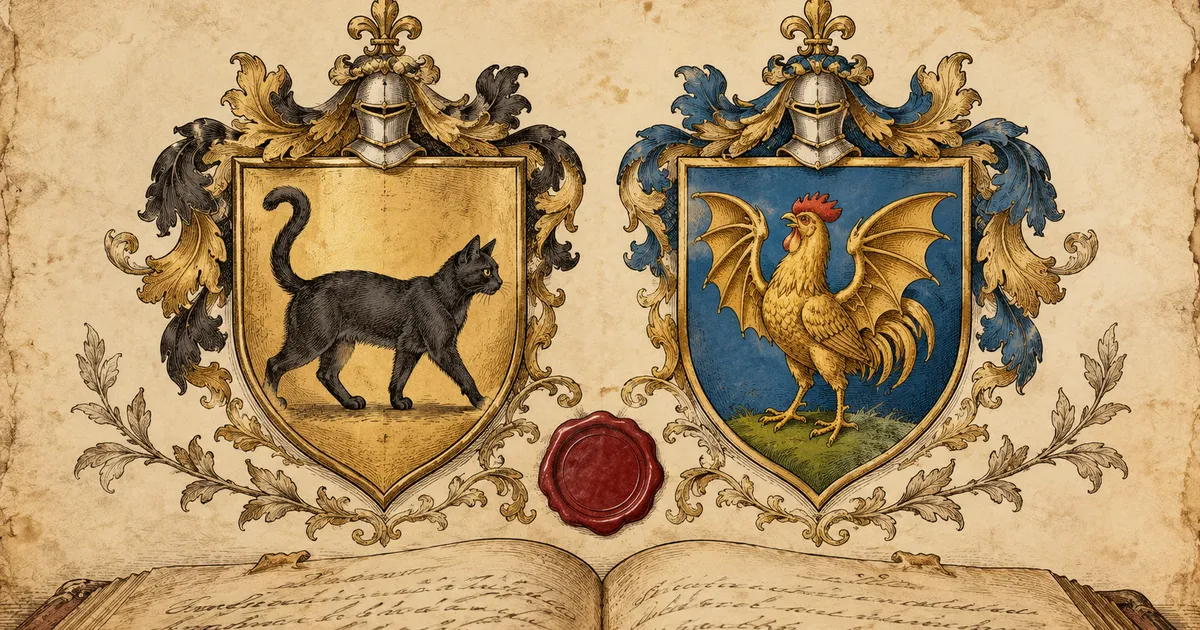
Search for your surname online and within seconds someone will offer to sell you “your family crest.” On parchment, on a mug, engraved on a ring. Type in the surname and the coat of arms appears, in full color and ready to print.
There’s a problem: a coat of arms shared by everyone with the same surname has never existed. Not for your surname, and not for any other.
You inherit a surname, not a coat of arms
A coat of arms belonged to one specific family: a single branch, descended from one founder, in one specific place. It was used to be recognized, to seal documents, to mark one’s belongings. It passed to the descendants of that branch, and to them alone.
Surnames took a different path. Many Italian surnames, especially the most common ones, were born more than once, in different towns, among people who had never met. A baby named Bonanno, meaning “good year,” could be born in Palermo just as easily as in Rome. His children became “the Bonannos,” with no tie at all to the Bonannos of another city.
So two families with the same surname may have nothing in common. Least of all a coat of arms.
Two surnames, four coats of arms
Heraldic archives show this clearly. For the same surname they often record different coats of arms that look nothing alike.
Take Bonanno. The noble Bonannos of Palermo had a coat of arms described as “Or, a cat passant sable.” In plain words, a black cat walking across a gold field. A Bonanno family in Rome had instead a silver shield with a red chevron and three red four-leaf clovers.
The same goes for Basile. A Basile family of Naples, counts of Torone, had a gold rooster with dragon wings standing on a green meadow. A Basile family from Santa Lucia del Mela, in Sicily, had an armored arm fighting a dragon with a spear. Next to it were a comet and a Maltese cross.
So which one would be “the Bonanno family crest”? The cat or the clovers? Neither, unless your family descends from one of those branches.
Who had a coat of arms
Coats of arms weren’t only for nobles. In the Middle Ages, merchants, notaries, craftsmen, towns, and religious brotherhoods used them too. As early as the 1300s, the jurist Bartolo da Sassoferrato wrote that anyone could choose a coat of arms, as long as they didn’t copy someone else’s.
Many families, though, never had one. Farmers, fishermen, and day laborers were the great majority of Italians, and a painted shield was of no use to them. If your ancestors were among them, your family most likely had no coat of arms. That’s the story of most Italian families, including most of those who emigrated to America.
How to spot an invented crest
Sellers of “surname crests” give themselves away with a few signs:
- one coat of arms per surname, without saying which family or which city it belonged to;
- no source: no armorial or archive where the coat of arms is recorded;
- no blazon, the technical phrase that describes a real coat of arms, like “Or, a cat passant sable”;
- the crest arrives instantly, before anyone knows where your family comes from.
A real coat of arms always has a family, a place, and a source. If any of the three is missing, what you’re buying is a drawing.
How to find out if your family had one
The path starts from your family, not from the surname.
- Build your family tree. Birth, marriage, and death records take you back one generation at a time, because each record gives the names of the parents. Many Italian records from the 1800s and early 1900s can be viewed for free on the Portale Antenati.
- Reach the hometown. Before the 1800s you move on to parish registers, which in many towns go back to the 1600s and sometimes to the 1500s.
- Search the armorials. Heraldic reference books record families and their coats of arms, with the city of each one. The most consulted are the Dizionario storico-blasonico by Giovanni Battista di Crollalanza and the Enciclopedia storico-nobiliare italiana by Vittorio Spreti.
- Find the link. The coat of arms belongs to your family only if a document connects it to the branch that used it. The same surname and the same town are not enough.
It’s long work, and it often ends with an honest answer: your family didn’t have a coat of arms.
What your surname really has
A coat of arms belongs to one branch. A surname belongs to everyone who carries it. And it always has a true story: what it means, where it was born, where it lives today, who carried it before you.
That’s what we tell in our PDFs. Every booklet has an honest page about the coat of arms, with the ones recorded in the archives when they exist. In the last pages you’ll find a family tree to fill in and a surname scroll to print, with its real meaning.
Want to know where your surname comes from? Look it up in the catalog or explore the volumes by area of Italy.